

The ongoing artificial intelligence boom is frequently framed as a cure for stagnant productivity. Tech giants report surging profits, markets rally, and economic models suggest that higher growth should make national debt piles far more manageable.
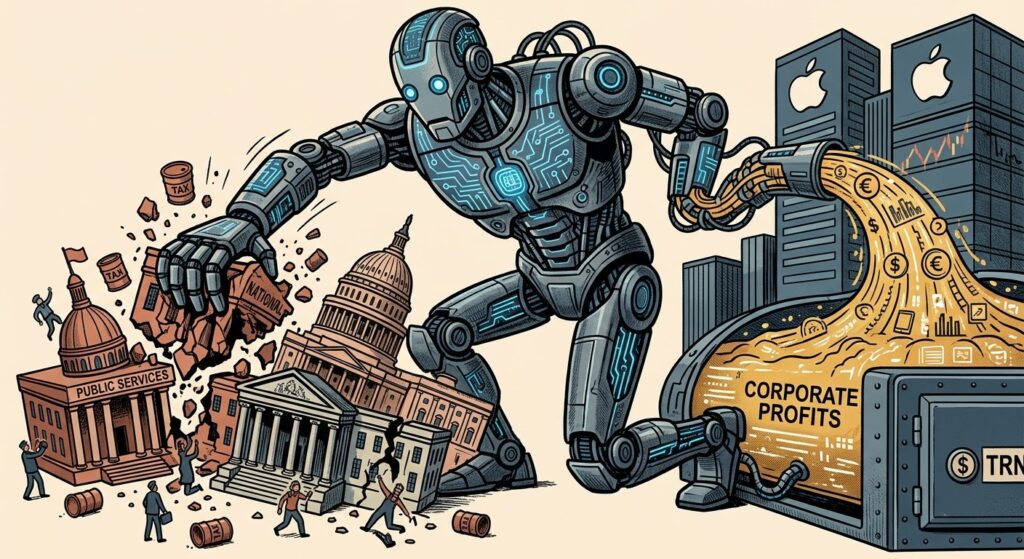
Yet reality presents an immediate paradox: despite massive corporate earnings, public tax receipts are not surging. In fact, many governments risk finding themselves severely starved of cash. The core issue lies in how Western democracies collect public revenue.
For decades, the tax base across the OECD has relied heavily on labor. In the United States, roughly three-quarters of federal tax revenues stem from personal income and social security contributions. European welfare models depend just as heavily on taxing human workers.
When technological progress shifts national income from labor to capital, this framework fractures. If high-margin software and automated infrastructure erode the labor share of income, traditional tax receipts dwindle.
Meanwhile, unusually high capital spending allows tech corporations to write off massive investments against their tax bills, muting corporate tax contributions. A recent analysis by The Economist highlights that if AI causes labor’s share of income to decline by ten percentage points, budget deficits in countries with heavy payroll taxes like Italy, Germany, and France could expand dramatically.
At the same time, the demands placed on the state will rise rather than fall:
- Baumol’s Cost Disease in Public Services: AI creates substantial productivity gains and raises wages in technical fields like software engineering. Essential public sectors that rely on human touch and presence—such as nursing, education, and municipal governance—do not see the same automated leap. Public institutions will be forced to raise compensation simply to retain talent, inflating the baseline cost of running a society.
- Support and Retraining Burdens: Displaced workers require income replacement, active labor-market programs, and social safety nets. Demands for wider welfare safety nets or basic income schemes will arrive precisely when traditional payroll revenues decline.
Fixing this structural imbalance requires more than stopgap measures. Ideas such as a direct “compute tax” on AI infrastructure risk raising modest revenue while driving tech development outside national borders. Dedicated wealth taxes often run into valuation disputes, avoidance structures, and capital flight.
If nations want to preserve the financial foundations of their public services and maintain strategic autonomy, tax architecture must evolve:
- Rebalancing Capital and Labor Taxes: Closing the gap between taxes levied on corporate capital gains and those levied on payrolls ensures the state benefits directly when productivity gains accrue to asset owners.
- Taxing Economic Rents: Imposing targeted levies on excess profits generated by digital network monopolies, unique datasets, and concentrated infrastructure avoids punishing early-stage innovation while capturing genuine windfall gains.
- Broadening Consumption Taxes: Consumption remains notoriously difficult to offshore or automate away. Shifting a larger share of public revenue toward broad-based consumption models, balanced by targeted social transfers, stabilizes public finances in an economy powered by software rather than payrolls.
Everything is figureoutable, but solving fiscal sustainability in an automated era requires political leaders to overhaul outdated tax models before structural deficits undermine sovereign stability.