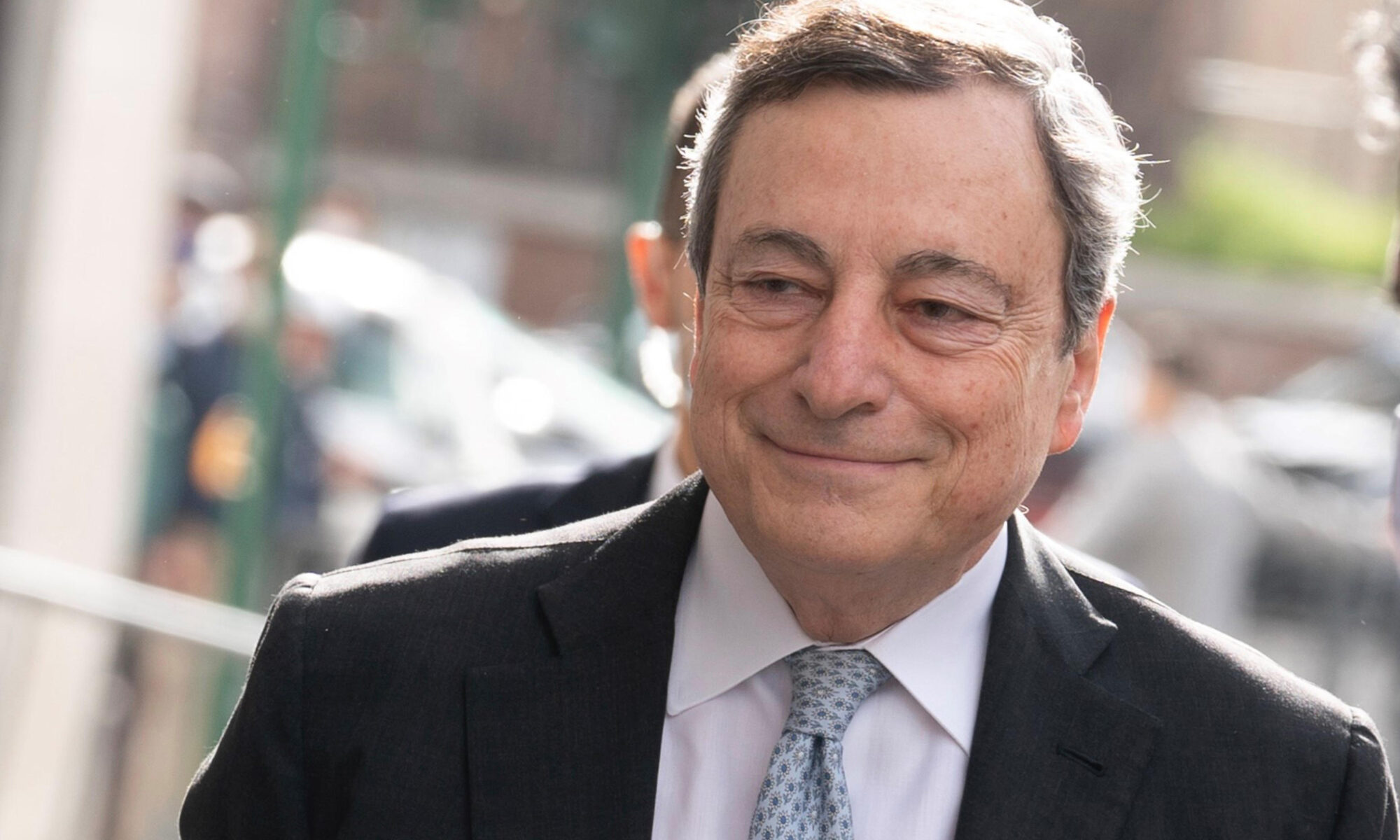
Former ECB President Mario Draghi Calls for a Federal Europe: “We Must Decide if We Want to Become a True Global Power”

Mario Draghi

Europe must transform into a federation to survive in a world where the United States and China are rewriting the rules of the game. This was the core message from Mario Draghi, former President of the European Central Bank (ECB) and former Prime Minister of Italy. “We must decide whether we want to become a global power or remain subject to the priorities of others.”

Mario Draghi - May 2021

Mario Draghi

Mario Draghi advocates for a European federation to stand firm against superpowers like the US and China. Receiving an honorary doctorate at the University of Leuven (Belgium), Draghi argued that Europe must choose between being a market subservient to outside interests or becoming a sovereign global force. He proposes “pragmatic federalism,” where willing nations start building joint institutions with real decision-making power in specific sectors.

​The Collapse of the Old World Order

​During his acceptance speech at KU Leuven, the man credited with saving the euro did not mince words regarding Europe’s precarious global standing. Draghi noted that the global order, which underpinned European prosperity for decades, has permanently collapsed. This shift is driven by the changing stances of major powers.

​”Beijing controls critical points in global supply chains and does not hesitate to use that power as leverage,” Draghi remarked. “Meanwhile, our traditional ally, the US, is increasingly focused on its own costs and less on the mutual benefits derived from cooperation with Europe.”

​”We are facing a future where Europe risks becoming
simultaneously subordinate, divided, and deindustrialized.”

Mario Draghi

​From Confederation to Federation

​To counter these threats, Draghi insists Europe must move away from its current model as a confederation (a loose collection of states with veto powers) and evolve into a true federation, effectively a “United States of Europe.”

​”A group of states that merely coordinates remains just a group of states,” he argued. “We must decide: do we remain just a large market subject to the priorities of others? Or do we take the necessary steps to become a global power?”

​He pointed out that while Europe acts as a unified bloc in trade, competition, and monetary policy (earning respect as a global player) it remains a “loose collection of mid-sized states” in areas like defense and foreign policy. This fragmentation makes the continent vulnerable to being “picked off one by one” by superpowers.

​The Greenland Precedent

​Draghi cited Europe’s military deployment to Greenland as a prime example of successful unity. This move followed repeated suggestions by U.S. President Donald Trump regarding placing the island under American authority.

​”By acting together against a direct threat, Europeans discovered a level of solidarity that previously seemed unattainable,” Draghi noted. He believes this shared determination resonated far more with the public than the typical declarations following European summits.

​Pragmatic Federalism

​Draghi’s solution is “pragmatic federalism.” This approach does not require every nation to hand over power in every sector immediately. Instead, he suggests that countries willing to cooperate should lead the way in specific domains such as energy, technology, or defense.

​”As Robert Schuman said in 1950, Europe will not be built all at once,” Draghi reminded his audience. “Not all countries will participate in every initiative from the start. The door remains open to others, but not to those who would undermine the common goal.”

​His vision involves building common institutions with genuine authority to act decisively under any circumstances. He pointed to the success of the Euro as the ultimate blueprint: a group of countries took the lead, built institutions with real authority, and created a bond of solidarity that goes deeper than any treaty.

Watch Mario Draghi’s speech in Leuven (from the 4th minute onwards):

Economists Warn: The European Union Must Act

Dark clouds are looming over European industry. More experts are sounding alarms about the EU’s economic transition. A worrying signal came this week with the quarterly figures of Germany’s biggest carmaker, Volkswagen.

@roelthijssen

“If we do nothing, in fifty years, Europe will be just an open-air museum for American tourists,” warned former European Central Bank president Mario Draghi in a recent report on the EU’s economic future.

Most countries agree that action is needed. But what should Europe do to remain a global financial power alongside China and the United States? Economists say clear goals must be set and significant investment made over the coming years.

In Europe, much thought is being given to this. The EU remains a global player but risks being overtaken by emerging economies in the coming years. China has invested heavily in the green industry for years. Over the past ten to fifteen years, the country has become a major producer of solar panels, everyday semiconductors, and batteries.

Now, China is also making significant strides in the production of electric cars, putting pressure on European automakers from their East Asian competitors.

Europe is also increasingly struggling to keep pace with the United States. Of the fifty largest tech companies, only four are from the EU. Over the past decades, numerous startups in the U.S. have grown into major companies with trillion-dollar valuations.

Everyone in Europe agrees that something must be done, but what? “If we Europeans think we can build major companies from the ground up in just a few years, we are mistaken,” says Samuele Murtinu, professor of economics at Utrecht University. Competing with other global economies will require a lot of time and money.

Should European industrial companies collaborate more closely?

This happened with General Motors in the United States, now one of the world’s largest car companies. A successful European example is Airbus, which began in the 1960s as a collaboration between British, French, and German aircraft manufacturers.

However, economists see little support for this idea. Market competition leads to lower prices. “There was an idea to merge large European companies, but this was ultimately prohibited due to monopoly concerns,” says Niclas Poitiers, an economist at the EU think tank Breugel. “It would be a death knell for other existing European companies.”

Alarm

What everyone does agree on is that significantly more money needs to be invested in the European economy soon. The United States is investing $700 billion in the green transition. Estimates suggest China is doing the same, but Europe does not yet have a unified plan.

Former ECB chief Draghi also proposed such an amount for the EU. Some may be alarmed by this, but economists warn that if Europe is not willing to invest in the new economy, the price could become even higher. Without a long-term view, it may soon be too late to catch up.

Five Tips for the EU from Economists

Be bold in investing heavily in sustainability over the coming years.

Collaborate, even with companies outside the EU.

Gain control over the supply of essential raw materials.

Set clear political objectives.

Countries must come together for more unified policies.

Besides funding, having a clear plan is crucial for Europe. Although the 27 EU member states form a union, they often do not align their national policies. The member states also seem divided on their priorities.

What is more important: accelerating sustainability or maintaining major European companies and thus preserving jobs? Opinions on this choice currently differ significantly.

Nevertheless, it is not an impossible task. Europe has faced bigger challenges in the past. “The closure of coal mines was actually the last major transition,” says Poitiers. “A huge number of jobs were lost back then. I estimate this green transition to be smaller. I don’t expect as many jobs to be at risk.”

European tech sector lags behind the U.S. Market value of companies in billions of euros:

European Union:

NXP Semiconductors: 59, Spotify: 72, ASML: 255.

US:

Amazon: 1,870, Alphabet (Google): 2,040, Microsoft: 2,980, Apple: 3,250.

Draghi: Hundreds of billions extra needed to save the European economy

It is high time for a drastic overhaul of European economic policy. The survival of the European Union is at stake, facing an “existential challenge.” These strong words come from a report on the future of European competitiveness presented this morning by former European Central Bank head Mario Draghi. According to him, hundreds of billions of euros are needed annually.

@roelthijssen

Last year, Draghi was asked for advice by Ursula von der Leyen, President of the European Commission. The European economy lags behind the US and China. Disposable income growth in the US has been nearly double that of Europe since the early 2000s, Draghi writes.

The struggles of European industry were highlighted again last week when Volkswagen considered closing factories in Germany due to increasing pressure from Chinese competitors.

At a press conference this morning, Von der Leyen stressed that improving the economic position is “top of the agenda,” with Draghi’s report serving as guidance for the new European Commission.

Investing in innovation
Draghi points out that all three factors driving European economic growth—thriving international trade, cheap Russian energy, and America’s defense of Europe—have become uncertain or have disappeared. Significant changes are needed in the EU, according to Draghi.

Investing more in knowledge and innovation is crucial for the EU to compete with economic giants like China and the US. Currently, the EU is “punching below its weight,” writes Draghi. He calls for removing strict regulations and barriers hindering innovative entrepreneurs in Europe.

Expensive energy
Energy policy is another challenge. Since Russia stopped supplying cheap energy following the invasion of Ukraine, gas prices for European industry have risen to over three times those in the US. The EU needs to accelerate its clean energy plans, Draghi urges.

The report includes over 170 concrete proposals to bring about the “radical change” needed, according to Draghi.

The EU must also become more self-reliant in security matters, investing and collaborating more in defense. Additionally, the EU should ensure the supply of crucial raw materials, forming partnerships with resource-rich countries and increasing domestic production, such as opening new lithium mines.

Various EU processes must also change. For example, the report suggests better coordination of competitiveness and quicker decision-making in the European Council by reducing veto powers.

Download the report here -> https://www.roelthijssen.nl/wp-content/uploads/2024/09/The-Future-of-European-Competitiveness-2024.pdf