
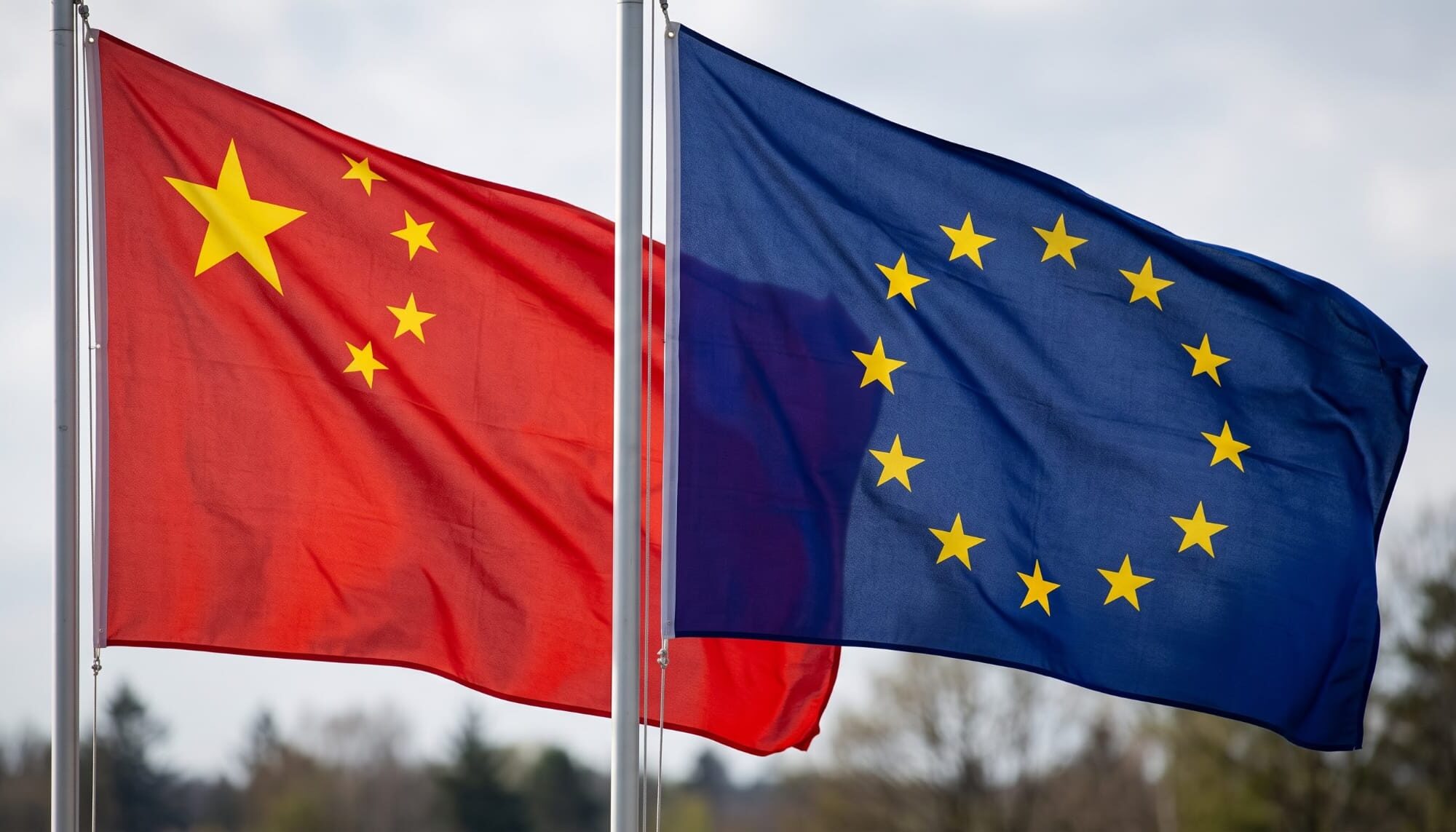
Trade Confrontation Looms: ‘Super Crucial’ Meeting Between the EU and China

EU-China relations

Beijing hosts high-stakes talks between the European Union and China today and tomorrow. Following months of escalating trade friction, EU Trade Commissioner Maroš Šefčovič meets Chinese Commerce Minister Wang Wentao.
EU-China relations
EU-China relations

The European Union is demanding an immediate resolution to an increasingly lopsided trade deficit, which has widened to roughly 1 billion euros per day. European industry and employment are bearing the brunt of this imbalance. Šefčovič has described the talks as “super crucial.”

China benefits from the current status quo, drawing significant revenue from European consumers. With its domestic economy sluggish, an increasing share of China’s growth depends directly on exports.

A Sharper Tone

​The European Union’s rhetoric has hardened considerably in recent months. In her address to the European Parliament, Commission President Ursula von der Leyen stressed that the EU-China dialogue must deliver concrete results. Otherwise, the EU will “use all tools at our disposal to rebalance the relationship.”

Brussels accuses China of unfair trading practices, including state subsidies and keeping its currency artificially low. European companies struggle to compete under these conditions.
​If the meeting fails to yield tangible progress from the EU’s perspective, trade measures could follow. These may include tariffs or outright restrictions on Chinese imports.

Little Urgency to Compromise

There is little sympathy in Beijing for European grievances. Chinese officials point to the competitive strength of domestic industry: streamlined supply chains, advanced manufacturing, and low-cost logistics that rapidly deliver goods directly to European consumers.

That explanation overlooks key structural imbalances. European firms consistently face market access barriers in China that Chinese firms do not encounter in Europe. Chinese companies also benefit from subsidized loans, state aid, and free land or industrial facilities.
​Beijing believes it has little reason to compromise. Viewing the EU as fragmented, Chinese policymakers often minimize concessions by attempting to play individual member states against one another.

This playbook is well-established. When the European Commission moved to impose tariffs on Chinese electric vehicles last year, China responded with duties targeting French cognac, pressuring Paris to reconsider its stance. If the EU introduces new trade barriers now, a targeted Chinese counter-response is virtually certain.

The European Strategy

The EU aims to negotiate limits on specific exports to Europe, such as hybrid vehicles, while securing greater market access for European producers inside China.
​If negotiations stall, the EU warns it will levy additional tariffs on sectors experiencing extreme Chinese market dominance. Furthermore, Germany and France have proposed a more aggressive mechanism designed to swiftly restrict Chinese market access within the EU single market.

Germany’s backing represents a significant policy shift. Berlin long maintained a cautious approach toward Beijing, wary of potential retaliation against the German automotive and industrial sectors.

Decisive Decisions Ahead

Next week, Commissioner Šefčovič will present the outcomes of the Beijing meetings to EU heads of government during an EU summit in Brussels. That gathering will reveal whether member states are prepared to enact decisive trade measures, even if those actions drive up consumer prices at home.

Trade analysts argue that the long-term economic damage of inaction far outweighs the short-term pain of intervention. The coming weeks will demonstrate whether the EU can maintain collective resolve, or if internal division once again prevents meaningful action.


Europe’s Illusion of Peace: Why Diplomatic Protests Will Not Stop Russian Sabotage

Russian Agression

​For years, European capitals comforted themselves with a convenient euphemism: “hybrid warfare.” It was a neat, bureaucratic label that allowed leaders to file sabotage, arson, cyberattacks, and targeted strikes under the banner of ambiguous gray-zone activity. Because if an act of aggression does not arrive in the form of a declared military invasion, no one is forced to invoke mutual defense clauses, redraw budgets, or make politically uncomfortable decisions.

Russian Agression
Russian Agression

Recent events in Germany make that comfortable fiction impossible to sustain. When a drone assault targets a Ukrainian cargo plane at Leipzig airport using military grade explosives and detonators linked directly to Russian state operations, that is not merely an incident. When power substations in Brandenburg and Bergheim are sabotaged within days of each other, and grenades detonate near Ukrainian nationals at Augsburg station, calling it a series of coincidences is willful blindness.

Even Brussels has begun to shift its tone, with European Commission leadership acknowledging the military nature of these operations and calling them what they truly resemble: state-sponsored terrorism on European soil.

Yet naming the threat is only half the battle. The far more alarming issue is the complete absence of a credible response.

​Closing two consulates and a cultural institute in response to physical sabotage on critical infrastructure is not deterrence. It is diplomatic theater. It signals to Moscow that operations within the European Union carry virtually zero cost. If the response to orchestrated physical disruption on EU soil remains confined to press releases, rapid-response advisory teams, and modest consular expulsions, then deterrence has failed before it has even begun.

The harsh truth is that Russian intimidation is working, largely because Europe’s domestic politics are beginning to crack under the strain.

Across the continent, war fatigue and economic anxieties are eroding the political resolve needed to push back against aggression. In Germany, regional elections threaten to elevate factions eager to roll back sanctions and sever aid to Kyiv. In Italy, internal political pressure mounts against continued defense commitments. In Belgium, debates stall over mobilizing seized Russian assets. Even in the Netherlands, prominent political voices openly parrot talking points that serve Moscow’s interests, seemingly oblivious to our own recent history and national security vulnerabilities.

Meanwhile, Washington makes no secret of its reluctance to guarantee European security indefinitely. The strategic umbrella that Western Europe relied upon for eight decades is fraying at both ends.

Europe is caught in a dangerous pincer movement: externally targeted by escalating state sabotage, and internally paralyzed by political fragmentation and military dependency. We want the benefits of peace without paying the price of autonomy. We demand security while refusing to build the sovereign industrial and defense capacity required to enforce it.
​Looking away has long been Europe’s preferred crisis management strategy. Delay the decision, form a committee, issue a condemnation, and hope the storm passes. But ignoring an adversary who is already operating inside your perimeter does not buy stability. It only guarantees that when the bill finally comes due, the cost will be catastrophic.

​If Europe wishes to remain master of its own destiny, it must trade performative outrage for tangible strength. That means real consequences for sabotage, genuine military autonomy, and the political courage to tell citizens the truth: peace is not preserved by looking the other way.