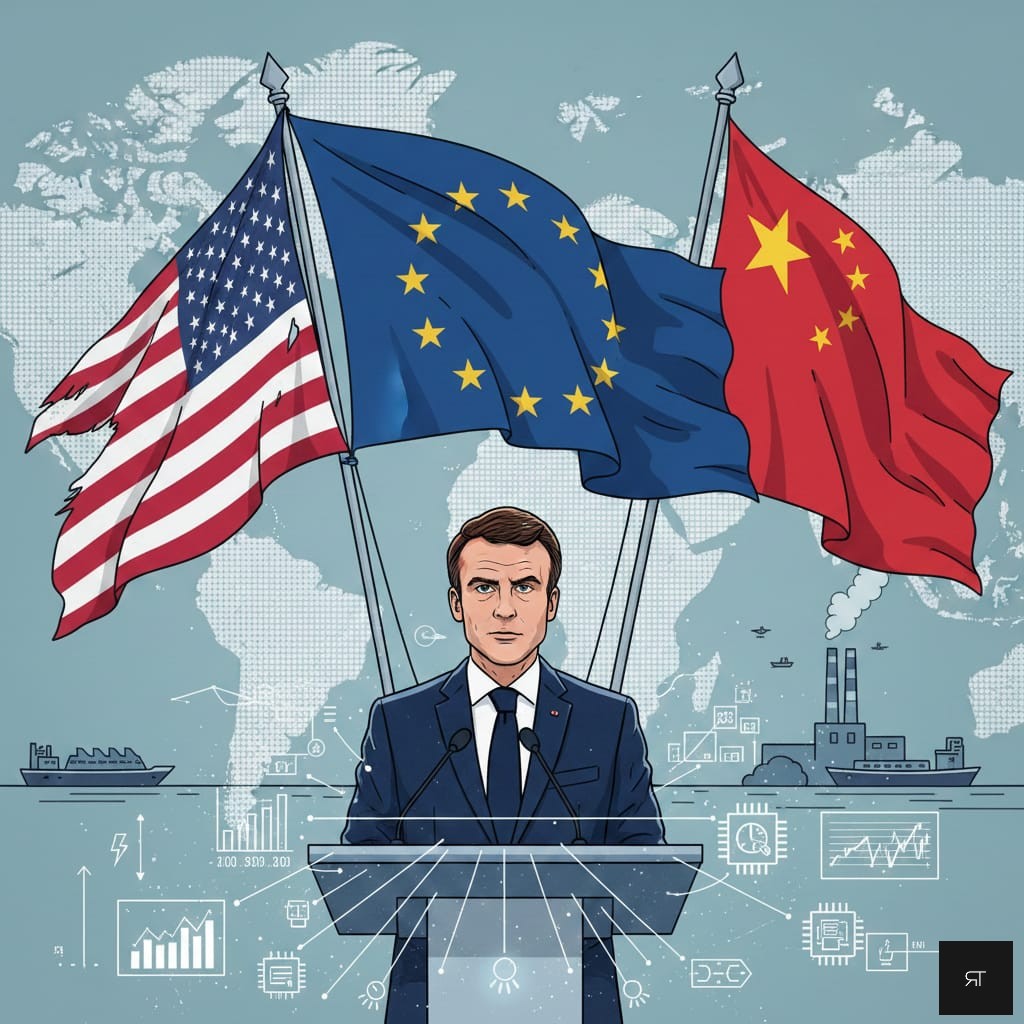
In the face of competition from the United States and China, Emmanuel Macron is calling for “joint investment.” In an interview with several European newspapers, the French President invited his European counterparts to invest in the ecological transition, artificial intelligence, and quantum computing to avoid being left behind.
Macron Calling for Joint European Investment in Strategic Sectors
A Call for Sovereignty and Shared Debt
”For nine years, I have advocated for a more sovereign Europe,” Macron stated this Tuesday, February 10, just two days before a meeting of EU heads of state and government in Brussels. The President believes that trade threats and “intimidation” from the United States are not over. He warned that the twenty-seven member states will be “swept away” if they do not establish a European preference in strategic sectors.
To cement European power, Macron is pushing for a common debt capacity to fund future expenditures (Eurobonds). This joint borrowing would finance strategic investments and allow the European Union to “tackle the hegemony of the dollar.”
Three Key Battles
Macron identified three critical areas where Europe must act within the next three to five years to remain relevant:
Security and Defense Green Transition Technologies Artificial Intelligence and Quantum Computing
“In all these areas, we invest much less than China and the United States,” Macron explained. He estimates the required public and private investment at approximately €1.2 trillion per year. He emphasized that these efforts must be collective rather than national to avoid fragmenting the internal market.
Consistent Protection, Not Isolationism
Regarding protectionism, Macron clarified that the goal is consistency rather than isolation. “The Chinese do it, the Americans do it too. Europe is currently the most open market in the world.” He argued that it is illogical to impose strict rules on European producers that do not apply to non-European importers.
He cited several examples of this new direction:
Opposing the EU-Mercosur trade agreement, which he labeled a “bad deal.”
Implementing taxes on over-subsidized Chinese electric vehicles.
Introducing safeguard clauses on steel.
The recently presented “Car Plan” by the Commission, which features a clear European preference.
The French economy has long been the problem child of the European Union. With the recently passed budget by Prime Minister Lecornu, little seems set to change. Economists and professors are increasingly alarmed by the state of France’s finances. “Our country has become the Argentina of Europe. France is trapped in a hellish spiral leading it toward third world status,” warns Nicolas Baverez, a renowned French economist.
French Economy in Decline
The current state of the French economy is clearly reflected in its inflation figures. While inflation in many European economies has stabilized around 2%, Paris reports an unexpectedly low figure of 0.4%. For years, France has struggled with sky high national debt, while the budget deficit continues to spiral out of control. Attempts to tackle these deficits repeatedly hit a political dead end. Furthermore, major reforms never see the light of day because the French parliament is extremely divided, a situation that recent parliamentary elections have failed to resolve.
A Tax Trap
The core of the problem is that potential tax hikes may not provide a way out. Although they increase revenue, the national debt will continue to grow as long as government spending remains unchecked.
Frédéric Douet, a professor of private law, observes how France is “slowly impoverishing” due to “consistent policies that are both costly and inefficient.” Writing in an op ed for Le Figaro, he expressed his disdain: “The mantra of our technocrats and politicians is that higher taxes will solve our problems.”
High Unemployment and Low Productivity
These concerns are well founded. For the third consecutive year, France’s GDP per capita has fallen below the European average. Additionally, inflation sits far below the eurozone average, and the country faces significantly higher unemployment than the EU mean. Baverez warns that raising taxes will be counterproductive, pushing more people into poverty without necessarily generating immediate revenue.
The economist is also critical of the tax measures in the new budget, which aims to raise an additional 44 billion euros, including 12 billion euros from the corporate sector. Baverez warns that these plans accelerate France’s “financial suffocation” and create “the conditions for a major financial shock.” If France continues on this path, he fears the country will “no longer be among the world’s ten largest economies” by the end of this decade.
Future of the EU: Fewer regulations, more investments, and improved cooperation are needed to keep Europe viable, according to French President Macron. “The awakening is too slow.”
Macron @ Sorbonne 25-04-2024
Macron delivered his speech at the Sorbonne University in Paris in front of students, French politicians, and European diplomats.
Europe could die, and decisions must be made now to prevent this. This grave message was at the heart of the speech delivered by French President Emmanuel Macron on Thursday morning in the lavish amphitheater of Sorbonne University in Paris. The successive shocks that Europe has faced in recent years with the coronavirus pandemic, global trade conflicts, the war in Ukraine, and the rise of populism have exposed the weaknesses of the European Union, and according to Macron, immediate intervention is needed for the EU to withstand the test of time.
The weaknesses of the European Union are numerous and significant – the president named them one by one in front of students, French politicians, and European diplomats in a nearly two-hour-long speech. Macron is particularly concerned about the poor state of European militaries, which also lack cooperation, and dependence on other world powers in areas including defense, technology, food safety, and medicines. Also, the climate and biodiversity crises pose challenges to Europe, as do immigration at European external borders, foreign interference, and the lack of oversight on social media. “We do not set the rules in this digital space, where our democracy is shaped.”
The president came up with numerous proposals to make Europe a significant geopolitical player again, with the same core message: EU member states should cooperate more and invest more and smarter so the EU can become autonomous and compete with China and the United States. This is necessary, according to Macron, because these power blocs “no longer adhere to trade rules” with the massive support packages they are pumping into their economies.
To prevent Europe from being crushed, member states should invest heavily in existing sectors and several “sectors of the future” such as artificial intelligence, quantum mechanics, aerospace, biotechnology, and green energy forms. He also wants European countries to form more “real partnerships” with third countries to counteract the “bipolar confrontation” of China and the US. “We must show that we are a balancing power.”
Europe is also “too complicated,” Macron believes: there are too many and too complicated regulations, particularly in the area of climate. “It is not sustainable to have the strictest environmental rules, invest less, and be more naive [than other power blocs].” Trade rules within the EU would also weaken the international competitive position of the Union. “We need to dismantle the rules among the 27 countries so we can have a real shared market. Only then can you compete.”
Campaign Kickoff
In France, the speech is seen as an attempt by Macron to revive the campaign for the European elections of his Renaissance party. It could use it: the lead candidate Valérie Hayer struggles to gain momentum, in the polls the radical-right Rassemblement National leads by a large margin, and the third party, the Socialists, are dangerously close to Renaissance. As the socialist lead candidate Raphaël Glucksmann held a large gathering on Wednesday evening, it almost seemed like a duel between the two.
But within the Élysée, it is denied on all fronts that the speech is part of the European campaign. “It is a speech of a head of state speaking on behalf of France. (…) That is something entirely different,” says a source.
For the Élysée, ‘Sorbonne’ was mainly a continuation of the speech Macron gave in the same amphitheater in 2017. At that time – newly elected and very young – he was the one who put the theme of European autonomy on the European agenda with an inflated speech that is still often quoted. Then, it led to other EU member states tempering Macron’s words. But after the unrest and conflicts filled recent years, Macron sees that he has been proven right by his European partners. “The very French concept of sovereignty is increasingly spreading across Europe,” he said with satisfaction.
‘The EU is Awakening’
The French president was also cautiously positive about other developments. Where he portrayed a dozing European Union in 2017, he now described how member states have realized the dangers of being dependent on Russian gas and Chinese medicines. He celebrated the steps announced in recent years to reduce this dependence. He also repeatedly emphasized that the importance of the existence of the European Union is hardly disputed anymore. Where in 2017 radical-right parties like the Dutch PVV and the French Rassemblement National still advocated for Frexit and Nexit, “no one dares to talk about leaving the EU or the euro now.”
We are awakening, Macron concludes. “But the awakening is too slow.”
One year ago today, Emmanuel Macron was re-elected as president of France. Yet no one seems to be in the mood for a party. Macron is doing badly in the polls: only 26 percent of the French still trust him.
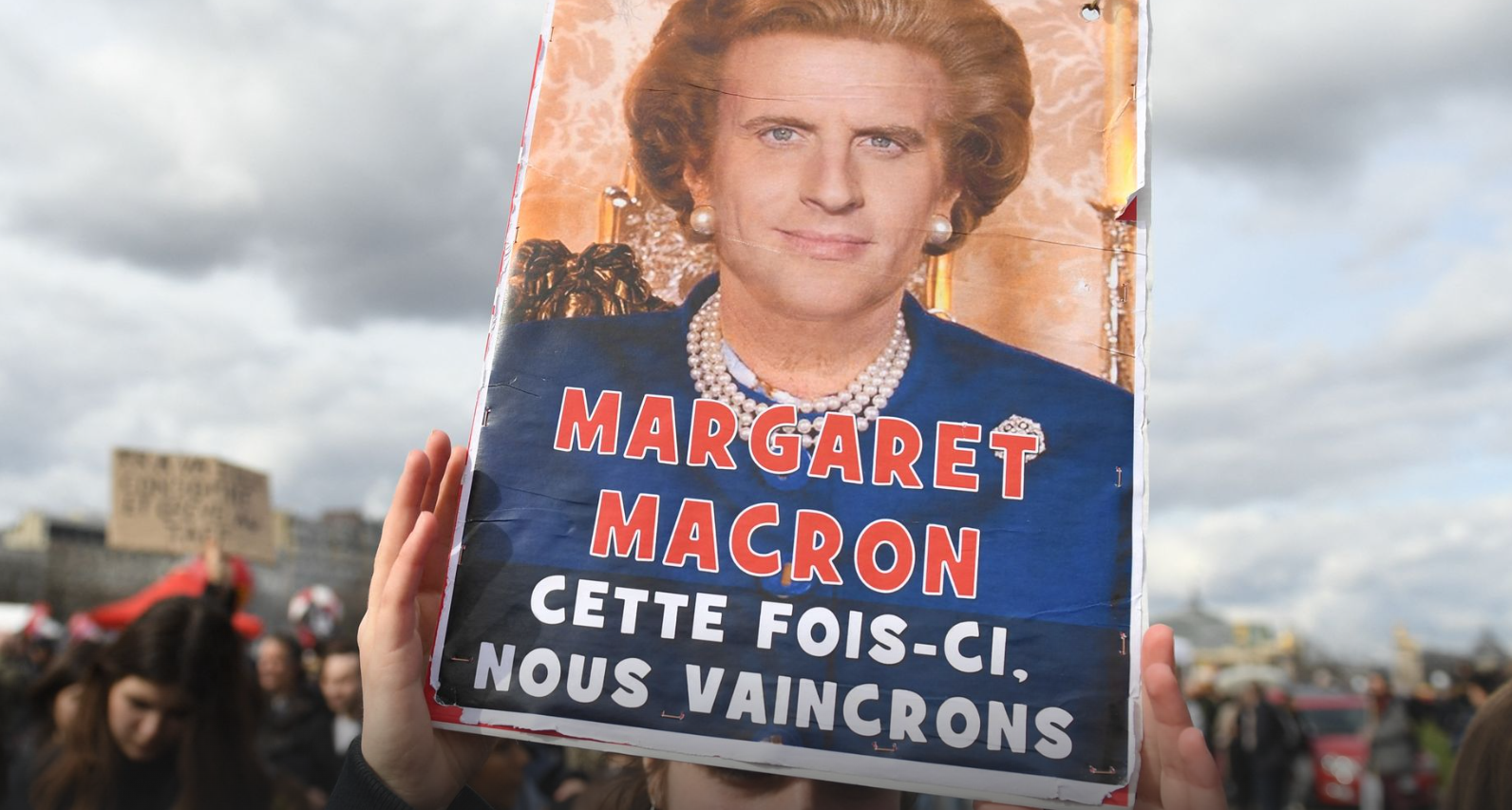
Protest signs against Macron, at a protest earlier this month – AFP
Demonstrations have been taking place across France against Macron’s pension reforms since January. This leads to concerns about the state of the country. “We are in the worst democratic crisis France has seen in decades,” said historian and sociologist Pierre Rosanvallon. Political scientist Adrien Broche sums up: “There is a social crisis, there is a political crisis and more than three-quarters of the French say that French democracy is in bad shape. In short: all signals are on red.”
From day one relatively little support
What’s going on in France? For that we have to go back in time. On April 24, 2022, Emmanuel Macron won the presidential election for the second time. He had already served five years as head of state and was therefore allowed by the voters to stay in office for another five years.\
But it was not a victory with flying colors. Many French people did not vote. As a result, Macron ultimately received the support of only 38.5 percent of all French voters: a minority. Legally it didn’t matter. The winner is the one with the most votes. But there were warnings about a president with relatively little public support.
Two months later, parliamentary elections were held in France. Macron’s party became the largest, but failed to win an absolute majority. From now on he was forced to negotiate with the opposition before passing bills.
The declining turnout also played a role in the background. The enthusiasm to vote has been decreasing for years among the French. For example, only 46 percent of the French entered the voting booth in the parliamentary elections. By way of comparison: in the Netherlands, the turnout in the last parliamentary elections was 78.7 percent.
President vs. population
In that climate, Emmanuel Macron began his second term in office. Raising the retirement age from 62 to 64 was the first major reform in that new political context: with little public support as president, and without a majority in parliament.
President Macron tried to overcome those obstacles. He initially wanted to raise the retirement age to 65 years, but because of social resistance he made a concession and made it 64 years. The resistance remained the same.,
Macron negotiated in parliament with the conservative opposition to gain support for his plans. That also failed; there was no majority. The result: the president pushed through a plan that the French did not like. He simply sidelined parliament because most MPs would vote against.
Meanwhile, three months of strikes and demonstrations by millions of French people have taken place, making the pension protests among the largest in French history. “The vote of the street should not outweigh the vote of the electorate,” the president said. He meant: the increase in the retirement age was in his election manifesto, so the voter knew what he was opting for. In fact, there is no in-between. But that ‘voter’s vote’ is the 38.5 percent of the French who voted for him. That is what many protesters mean when they say that Macron is not “the people’s president.”
The pension protests exposed the legitimacy problem warned about a year ago. Macron has too little support from the French and too few friends in parliament. Critics say Macron has driven voters away and antagonized the opposition.
Weak opposition
Macron’s opponents cannot make a fist either. The opposition in parliament is hugely divided. They fail to offer an alternative together or in coalitions. And the trade unions have mobilized millions of French people in recent months, but the result has been nil: the protest has had no effect. The pension crisis has only produced losers. “The crisis we are going through has not been good for anyone,” philosopher Florent Guénard said last month. “Democracy is divided and weakened. Emmanuel Macron is our legitimate president. But ‘legitimate’ does not mean you can do what you want. A president has responsibilities: he must listen.”
Emmanuel Macron still has four years left as president. He is now plotting a route for the next hundred days. In that short period of time, new policy plans must be launched, and he also wants to regain the confidence of the French.
Manage Cookie Consent
To provide the best experiences, roelthijssen.nl uses technologies like cookies to store and/or access device information. Consenting to these technologies will allow us to process data such as browsing behavior or unique IDs on this site. Not consenting or withdrawing consent, may adversely affect certain features and functions.
Functional
Always active
The technical storage or access is strictly necessary for the legitimate purpose of enabling the use of a specific service explicitly requested by the subscriber or user, or for the sole purpose of carrying out the transmission of a communication over an electronic communications network.
Preferences
The technical storage or access is necessary for the legitimate purpose of storing preferences that are not requested by the subscriber or user.
Statistics
The technical storage or access that is used exclusively for statistical purposes.The technical storage or access that is used exclusively for anonymous statistical purposes. Without a subpoena, voluntary compliance on the part of your Internet Service Provider, or additional records from a third party, information stored or retrieved for this purpose alone cannot usually be used to identify you.
Marketing
The technical storage or access is required to create user profiles to send advertising, or to track the user on a website or across several websites for similar marketing purposes.