Where is the Economic Doomsday We Were Promised?

If you had followed the economic forecasts at the start of 2025, you’d have been tempted to hide under the stairs with a blanket and a survival kit. The narrative was clear: the return of Donald Trump and his aggressive tariff regime would signal the end of the global economy as we knew it.

Experts predicted the largest trade shock in history, with some warning that a global recession was almost a mathematical certainty.
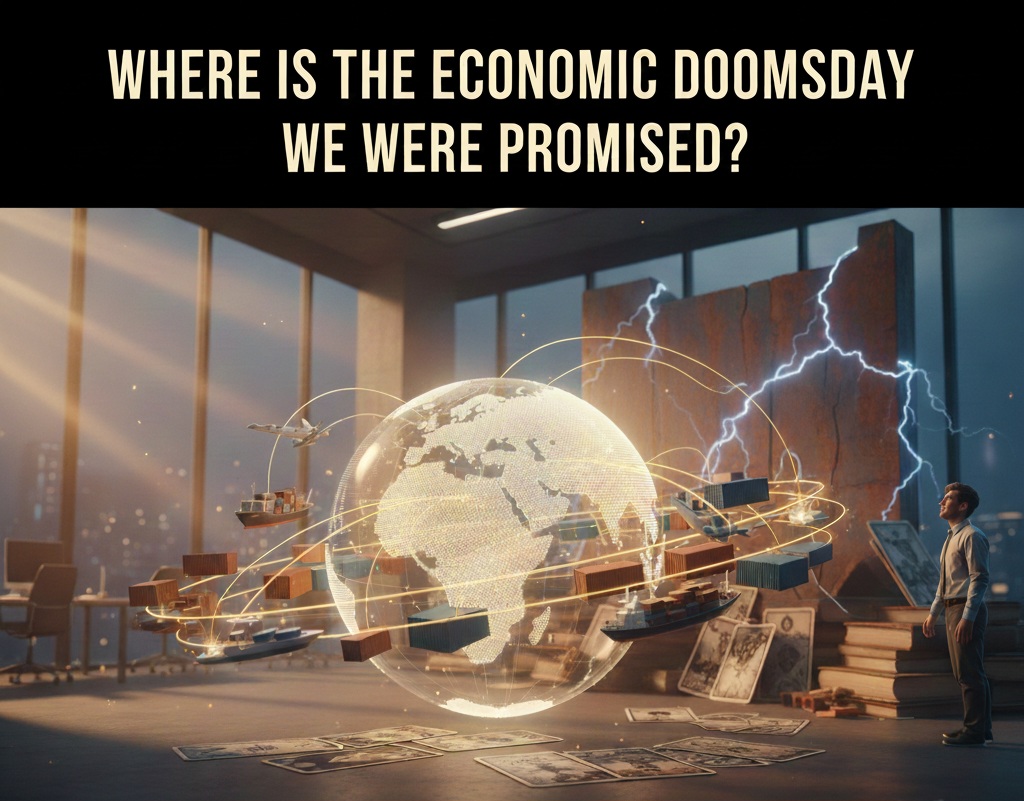
Yet, as we reach the end of the year, the wreckage is surprisingly hard to find. The world is still turning. While growth has slowed, the much feared recession hasn’t materialized. Global trade has undergone massive shifts behind the scenes, but it has neither halted nor collapsed. This raises a fundamental question: are our economic models broken, or has the global trading system proven far more resilient than anyone dared to hope?

Uncertainty as a Tool

One reason the dire predictions missed the mark is that they took initial announcements at face value. It has since become clear that the “April shock” of sky-high tariff announcements was a deliberate strategy of injecting uncertainty into the market to gain leverage. The goal was always to start high and negotiate down.
​While journalists and analysts were asking what the direct impact of a 27% tariff would be, the reality on the ground was a moving target. By November, after rounds of intense negotiations, the effective average tariff had dropped to 17%. While this is still significantly higher than the pre-2025 average of 2.5%, it is a far cry from the “total trade war” originally envisioned. Most major economic blocs managed to negotiate their way down, leaving China as the only player facing extreme rates above 40%.

Restraint and Resilience

The second reason we avoided a total meltdown was a surprising display of global self-discipline. The catastrophic scenarios relied on a domino effect of retaliatory tariffs. However, most of the world chose not to strike back in kind. Because the primary burden of a tariff falls on the country imposing it (as a tax on its own importers), the rest of the world avoided much of the pain by simply refusing to escalate. It was a calculated choice of restraint over ego.

Furthermore, global trade proved to be remarkably agile. We often think of international commerce as a slow-moving tanker, but this year showed it can pivot like a speedboat. When routes to the U.S. became too expensive, fleets redirected, and trade intensified within other regions. While exports from Europe to the U.S. have dipped, they haven’t cratered. Meanwhile, global trade in goods actually rose by over 6% this year. The old adage that “when America sneezes, the world catches a cold” no longer seems to hold true; we are moving toward a more balanced, less U.S. centric global economy.

The Hidden Toll

Does this mean the tariffs were a victimless policy? Far from it. While the “doomsday” didn’t happen, a slow erosion is visible beneath the surface.

The pain is currently being masked by corporate buffers. To avoid losing market share, exporters are slightly lowering their prices, while U.S. importers are eating into their own profit margins or cutting costs elsewhere rather than passing the full cost to the consumer immediately. Additionally, many companies stockpiled goods before the tariffs took effect, allowing them to sell older, cheaper inventory throughout the year.

However, these buffers are not infinite. Inflation in the U.S., which had been trending downward before the inauguration, has begun to creep back up. The promised manufacturing boom has yet to materialize, and job growth has stalled. Perhaps most tellingly, the tariff revenue is nowhere near enough to replace income tax, as was once claimed.

The real test will come in the next six months. As stockpiles empty and profit margins hit rock bottom, businesses will be forced to pass costs onto the public. This won’t just affect imported goods, but will trickle down into services like healthcare and hospitality. The economic “hell and damnation” didn’t arrive with a bang in early 2025, but for the American consumer, it may yet arrive with a whimper just in time for the midterm elections.
How Americans Have Been ‘Borrowing’ Money from the Rest of the World for Decades Without Consequences

It’s a strange phenomenon. Americans keep buying Mercedes cars and other expensive items—even though they can’t actually afford them. Normally, a country that does that would be in serious trouble. But we lend them the money to buy those things. What’s going on here?

US Dollar and other currencies

Trade Deficit
America has been living beyond its means for decades. They buy far more than they produce, and that gap is filled with imports. Last year, Americans bought over $1.2 trillion more from abroad than they sold abroad. That’s more than the Netherlands produces and consumes in a whole year. And they’re buying on credit—Europe or China lends them the money for those Mercedes cars and other goods.

Budget Deficit
It’s not just trade that shows a big deficit; government spending is also way out of balance. Last year, the budget deficit was $1.8 trillion, or 6 percent of GDP. The government structurally spends more than it takes in. Many developing countries are doing better financially than the U.S.

Normally, a country with such deficits would face a huge problem. Financiers would demand high interest rates for loans—if they’re willing to lend at all. That forces a country to make painful choices to fix its deficits.

Many developing countries are doing better financially than the U.S.

Greece
Take Greece ten years ago. The country had major deficits. To fix them, they had to slash government spending, which mostly hurt the public. Thousands of civil servants lost their jobs, and wages dropped sharply so they could become competitive with foreign countries again. For Greeks, no more new Mercedes—only second-hand Dacias.

But the U.S. has no problem financing its deficits. In fact, we’re lining up to lend them money. While Greece saw interest rates on new government bonds spike to 35 percent, the U.S. borrows at just 2 to 4 percent.

The Secret
There’s no talk of painful measures in the U.S. On the contrary, the government—recently with Congress’s approval—raised the debt ceiling again. So the state can borrow even more. Elon Musk might be laying off millions of civil servants, but not as a government spending cut. That money is meant for tax cuts, which means less income for the government.

So what’s America’s secret? How can they rack up debt for decades without serious consequences? The answer: the dollar.

This requires some explanation. The U.S. dollar is the world’s dominant currency. The vast majority of international trade transactions are settled in dollars—just think of the oil trade. As global trade grows, so does the demand for dollars. That demand helps the dollar maintain its value. This is a major reason why investors and countries keep investing in the U.S.

That’s why the U.S. can borrow at low interest rates despite its large deficit—unlike Greece, which had to offer sky-high rates.

Mountains of Dollars
Because many countries have trade surpluses with the U.S., they end up with large reserves of dollars. They reinvest those dollars in the U.S., buying U.S. government bonds—called treasuries. These treasuries are considered the safest government bonds in the world. And the market is enormous.

So you can always sell those bonds if you need dollars, or buy them if you have dollars to spare. The euro or the Chinese yuan offer nothing similar and thus can’t compete with the dollar.

There’s something ironic about it. The fact that Americans have such a massive and growing mountain of debt actually makes the dollar strong. And the dollar’s dominant position seems untouchable—there are no credible alternatives to the American currency.

A Drawback
But the dollar isn’t only beneficial to Americans. Because there’s always demand for dollars, the exchange rate stays high compared to other currencies. And that expensive dollar is a disadvantage for U.S. companies that export. It’s one reason much of U.S. industry has disappeared. Countries with weaker currencies can produce more cheaply.

That’s why Trump is trying to improve the competitive position of American companies by imposing tariffs on imports. That makes imports more expensive compared to domestic production.

Milton Friedman on Free Trade and Tariffs

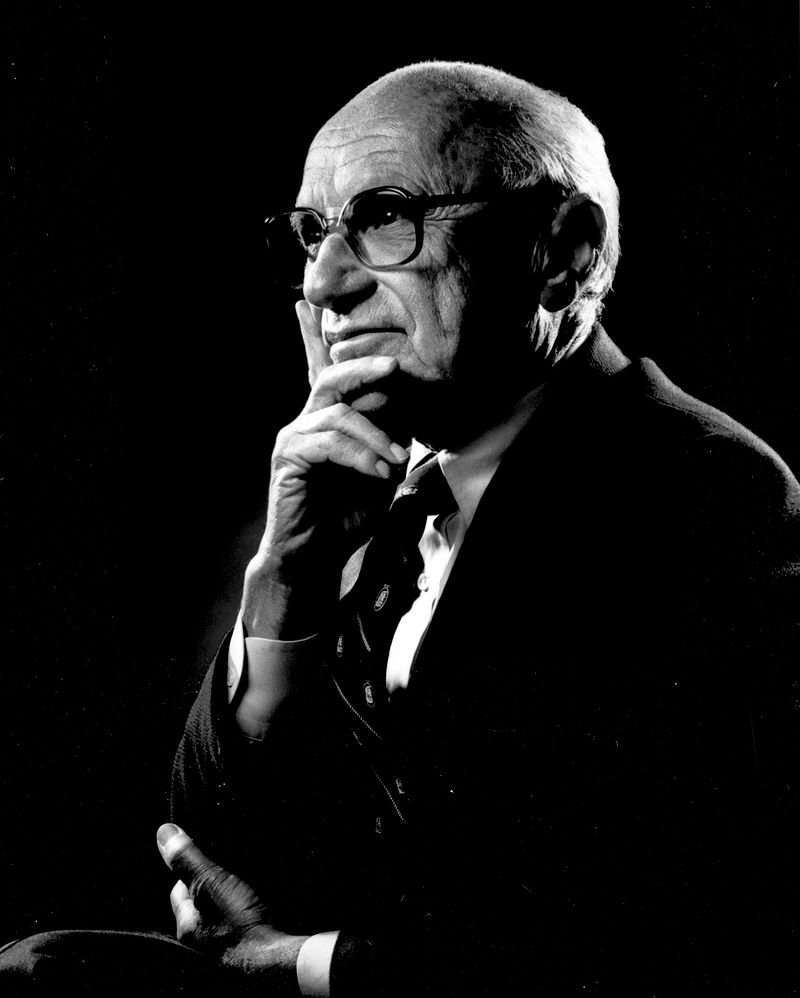
Milton Friedman, a Nobel Prize-winning economist and leading advocate of free-market capitalism, was a strong proponent of free trade and firmly opposed to tariffs.

Milton Friedman

He believed that free trade promotes economic efficiency, consumer choice, and global prosperity, while tariffs distort markets, protect inefficient industries, and ultimately harm consumers by raising prices.

Friedman argued that even if other countries impose tariffs, it is still in a nation’s best interest to keep its own markets open. He viewed trade as a voluntary exchange that benefits both parties and saw government interference, such as tariffs and quotas, as economically damaging and politically motivated.

In his view, the best policy was unilateral free trade — reducing or eliminating trade barriers regardless of what other countries do — because this would benefit the domestic economy by allowing consumers access to cheaper goods and encouraging competition and innovation among producers.

Is Trump the new Hoover, who plunged the world into the Great Depression with his tariffs?

The new American tariffs resemble those of President Herbert Hoover in the 1930s, which helped plunge the world into the Great Depression. Economists and historians consider them one of the greatest blunders in history. Trump does not.

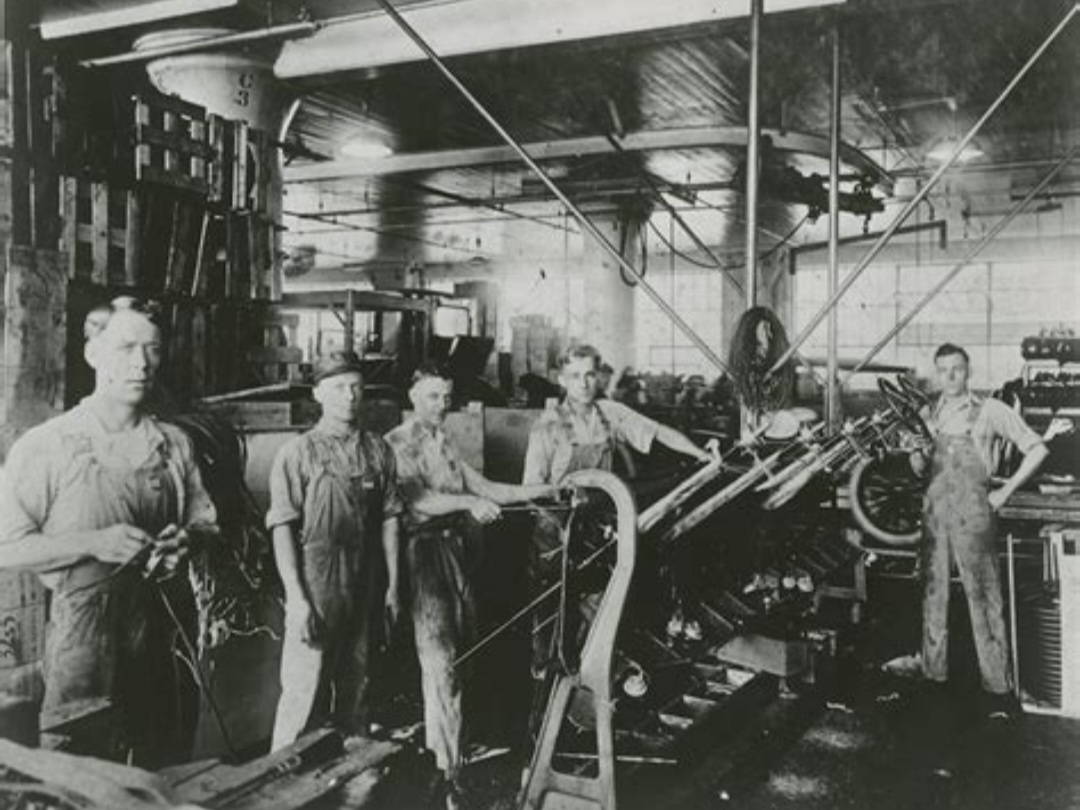
Workers in a Ford factory in Minnesota, 1935

Ben Stein is the most famous economics teacher in American film history thanks to Hollywood. He played the role of the dreadfully boring teacher in the 1986 movie Ferris Bueller’s Day Off. In a monotone voice, he attempts to explain the Smoot-Hawley Tariff Act, which was signed on June 17, 1930—eight months after the Wall Street crash of October 1929—by then-President Herbert Hoover.

On that “Liberation Day,” import tariffs were imposed on 20,000 goods from other countries in an attempt to protect domestic agriculture and industry from “unfair foreign competition.”

Stein can’t hold the students’ attention. By repeatedly asking, “Anyone? Anyone?”, he tries in vain to involve them. The film became a huge success.

Japan

When Wall Street experienced a crash on Black Monday, October 19, 1987—an even worse drop than Black Thursday in 1929—then-President Ronald Reagan decided to do absolutely nothing. As a neoliberal, free trade was sacred to him, even though the U.S. faced massive trade deficits at the time. China wasn’t the main culprit back then—Japan was, with its Datsuns, Toyotas, and products from Sony and Panasonic.

Barely a year later, the markets had recovered. World trade and the global economy would experience an unprecedented boom in the 1990s thanks to globalization and digitalization. After the credit crisis in 2008, the world’s major industrial nations—now united in the G20—decided not to worsen the looming recession and unemployment with protectionist measures.

Economists and historians consider Smoot-Hawley one of the greatest policy blunders in global history. Trump does not. The comparison is inevitable. Just like in 1930, the Republicans now control both the White House and Congress. And just as we are now in the midst of a technological revolution driven by social media and artificial intelligence, the 1930s were marked by one as well—leading to the loss of many “well-paid jobs” in agriculture and craftsmanship.

‘Economic stupidity’

Thanks to the gasoline engine and electricity, the 1920s saw a massive increase in productivity. In rural areas, draft and work animals were replaced by tractors and trucks. Land previously needed for grazing could now be used for production.

Like Trump, Hoover called the tariffs countermeasures. By the late 1920s, France had imposed 100 percent tariffs on American cars like the famous Model T. Italy and Germany had restricted imports of American grain. In 1928, Hoover won the presidential election with a promise to protect American jobs—just like Trump did last year.

Nevertheless, there was significant opposition to Smoot-Hawley. In May 1930, 1,028 leading economists signed a petition urging Hoover to veto the law. Automobile magnate Henry Ford called it “economic stupidity.” JP Morgan CEO Thomas Lamont said he “begged Hoover on his knees not to go through with the plan.”

Two-thirds untaxed

But Hoover stuck to his “beggar-thy-neighbor” strategy: improving one’s own economy at the expense of others by creating trade barriers. U.S. trade partners retaliated. Canada was the first to impose tariffs on sixteen key American products, which together accounted for 30 percent of total U.S. exports to the country.

American exports to countries that responded—among them Canada, France, Cuba, Mexico, Spain, Argentina, and Switzerland—fell by 31 percent. In the following years, the highest tariffs rose to nearly 60 percent on some products. But unlike now, two-thirds of imports remained untaxed. Trump’s tariffs apply to all imports.

Weak financial system

World trade collapsed in less than four years. U.S. imports dropped 66 percent, from $4.4 billion in 1929 to $1.5 billion in 1933. Exports fell from $5.4 billion to $2.1 billion. GDP was cut in half, from $103 billion in 1929 to $55.6 billion in 1933. Unemployment rose from 8 percent in 1930 to 25 percent in 1933.

Not everyone blames Smoot-Hawley for that. According to monetarists like Milton Friedman, the weak U.S. financial system was more to blame for the Great Depression than protectionism—after the crash, 9,000 of the 25,000 banks failed. In 1930, trade only accounted for 5 percent of U.S. GDP. Today, it’s 25 percent.

‘Never again’

Regardless, it was a vital lesson. After World War II, Western nations made massive agreements under the motto: never again. Organizations were created to promote free trade. In 1947, GATT (the General Agreement on Tariffs and Trade) came into effect, gradually reducing import barriers.

Whether Trump has seen Ferris Bueller’s Day Off is unknown. He may have fallen asleep. Either way, he shows no regard for the fact that after Smoot-Hawley, the Great Depression followed—a prelude to another world war.