
Europe Over-Regulating AI, Warns Top Tech CEO

AI Act Europe

​The European Union is stifling artificial intelligence innovation and pushing tech companies out of the region with burdensome rules, warned Christophe Fouquet, CEO of ASML.

​As the head of Europe’s most valuable tech company, Fouquet noted that the bloc’s restrictive regulatory approach is out of touch with actual industry needs. ASML, valued at 515 billion euros and based in the Netherlands, manufactures the highly advanced lithography machines required to print the world’s most sophisticated microchips. These chips power everything from smartphones and data centers to the complex AI models currently transforming the global economy.
​A Growing Rift Over the AI Act

In an exclusive interview, Fouquet highlighted a growing divide between Brussels policymakers and major industrial leaders. He specifically criticized the EU’s landmark AI Act, pointing out that European authorities are imposing strict boundaries before local companies have even had a chance to build competitive products.

​”We didn’t start running, we didn’t start even walking, and we already had in front of us all the obstacles to not be able to make even the first step,” Fouquet stated, adding that this approach does not serve the industry.

​The disconnect is highly visible in ASML’s own commercial data. An astonishing 99 percent of the company’s machine sales currently come from outside of Europe.

​This warning follows a joint letter sent to European Commission President Ursula von der Leyen by a coalition of Europe’s largest industrial giants, including ASML, Airbus, Ericsson, Nokia, and Siemens. The companies collectively warned that over-regulation risks permanently hobbling European firms in the face of intense competition from American and Chinese rivals.

​The Problem with Subsidizing Supply Without Demand

​While EU policymakers recently introduced an “omnibus” simplification package to ease some rules for industrial AI applications, Fouquet dismissed the logic of creating overly complex legislation just to scale it back later. Instead, he urged Brussels to collaborate directly with businesses when drafting industry frameworks.

​Fouquet also cautioned against the EU’s upcoming tech sovereignty package, which aims to build up domestic data centers and microchip factories. He argued that spending massive amounts of public subsidies on manufacturing plants is pointless without first stimulating local market demand for AI applications and cloud infrastructure.

​As an example, he pointed to Intel’s collapsed project to build an advanced chip factory in Germany. Fouquet noted that because Europe currently lacks a robust ecosystem of companies utilizing ultra-advanced chips, any wafers produced by such a factory would simply end up being exported to the United States.

​In response to the criticism, European Commission spokesperson Thomas Regnier defended the legislation, stating that the AI Act ultimately fosters investment by increasing consumer and industry trust. He emphasized that the recently updated rules offer clearer timelines and a more innovation-friendly environment for European tech companies.
How the EU Wants to Close the Gaping Holes in Its Semiconductor Industry

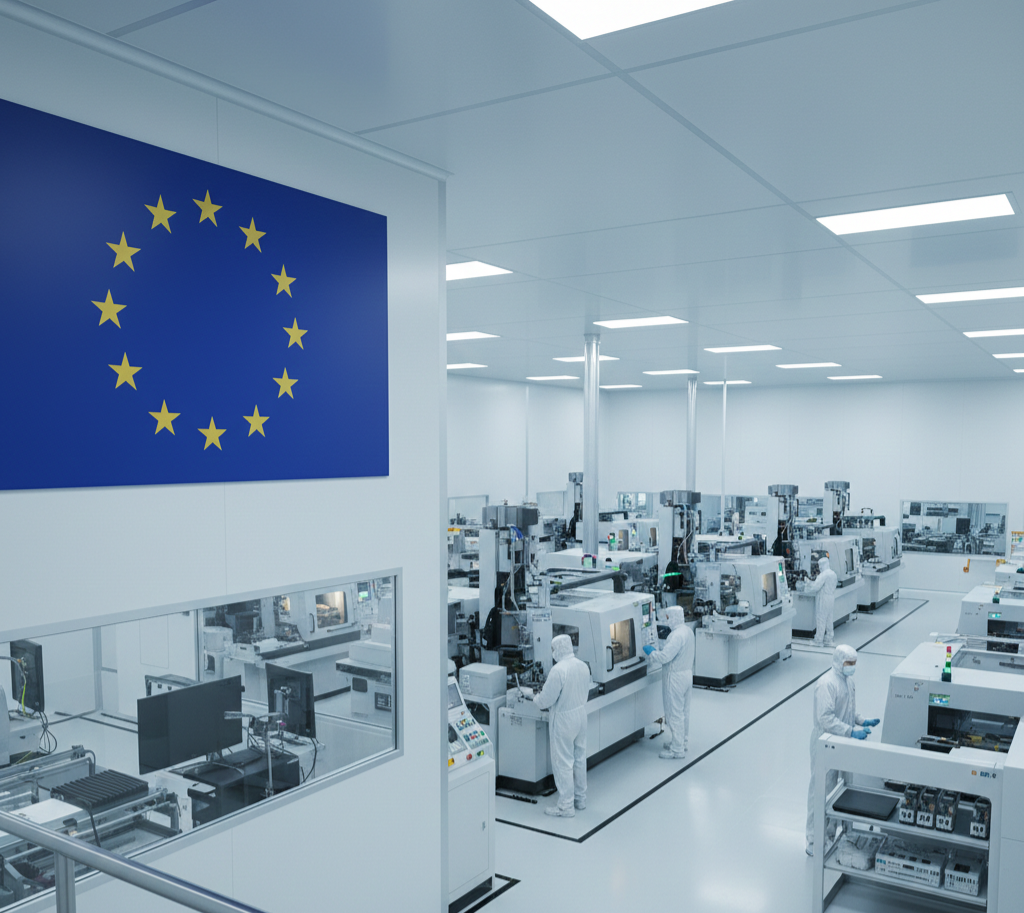
The European Union is working on a second “Chips Act” to strengthen its own, independent semiconductor industry. Not only for cutting-edge AI chips, but also for basic, low-cost chips used in everyday products like cars.

Semiconductor Industry Europe
© roelthijssen.nl

The message from Brussels is clear: Europe must become less dependent on foreign technology and more resilient in times of geopolitical crisis. But how realistic is that ambition?

At a semiconductor conference in Munich, European Commission official Pierre Chastanet admitted that Europe was caught off guard by the recent Nexperia crisis. The company, now owned by Chinese investors, became the center of a diplomatic conflict after Dutch government intervention. The result was risks to Europe’s automotive supply chain and the threat of yet another chip shortage. For Chastanet, it was a painful reminder that Europe’s chip supply is far less secure than it would like it to be.

From the First Chips Act to a Second Wave

The first European Chips Act, launched in 2022, marked a turning point in EU industrial policy. A total of 43 billion euros was mobilized, mainly through national governments and the EU budget, to stimulate semiconductor production in Europe. This helped attract major investments, including the ESMC chip plant in Dresden, a joint venture between TSMC, NXP, Infineon and Bosch, which is expected to start production in 2027. GlobalFoundries is also expanding its presence in Germany and France.

But not everything has gone according to plan. The major Intel investment in Magdeburg has been postponed, and a new plant in Crolles, France, is facing delays. Critics argue that smaller European technology firms still struggle to access high-end production facilities and infrastructure, limiting the emergence of true European chip champions.

Chips Are Geopolitical Power

Semiconductors are more than just technology. They have become a key geopolitical asset. Today, Europe remains heavily dependent on the United States and Taiwan for advanced AI chips. Taiwan, however, sits at the center of growing tensions with China, making Europe’s reliance on Taiwanese production a strategic vulnerability.

Although a planned American law to restrict AI chip exports, known as the AI Diffusion Act, was eventually scrapped by Donald Trump, the dependency remains. Europe cannot afford to entrust its digital future entirely to foreign powers.

Experts argue that chips will be one of the most important geopolitical instruments of the coming decades. The automotive industry, for example, will need increasingly advanced semiconductors for electric vehicles and self-driving technology. Ideally, those chips should come from European factories. Yet production in Europe is expensive, and manufacturers will only invest if there is sufficient demand.

The Missing Link: European System Champions

Europe is not starting from zero. Companies like ASML, for chip equipment, ARM, for chip architecture, and research institutes such as Imec in Belgium and Leti in France form a world-class ecosystem. The EU also holds strong positions in photonic chips and quantum technology.

What Europe lacks, however, are so called system champions, such as Nvidia, Apple or Huawei. These are companies that not only design chips but also shape entire technology ecosystems around them.

Taiwan’s success, experts note, is not based on one-off subsidies, but on long-term government support, tax incentives and continuous investment in the wider technology ecosystem. That is a key lesson the EU would need to embrace.

Practical Obstacles

Beyond strategy and money, practical problems remain. Building a chip factory in Europe takes about twice as long as in Taiwan. Bureaucracy, complex regulation and a shortage of skilled workers are slowing projects down. A single new fabrication plant can require up to a thousand specialized welders, professionals who are currently in short supply across Europe.

Reality Check

The original goal of producing 20 percent of the world’s chips in Europe now looks unrealistic. Out of around 5,000 standard ASML lithography machines worldwide, only 400 are located in Europe. According to ASML representatives, Europe’s chip industry is growing only half as fast as in other parts of the world.

Still, the EU sees no alternative. If it wants to remain economically, technologically and militarily relevant, it must close the massive gaps in its semiconductor industry. The second Chips Act is not just an industrial program. It is a geopolitical necessity.