​The Greenback’s Fall: A Systemic Shock to Global Confidence

US Dollar Collapse

The US dollar suffered a historic blow on Tuesday January 27th, sending ripples through global financial markets. In a final hour of frantic trading, the currency breached the crucial support level of 96.00, entering a freefall that bottomed out at 95.38.

For the world’s primary reserve currency, a single-day loss of over 1.1% is not just a dip; it is a systemic shock.
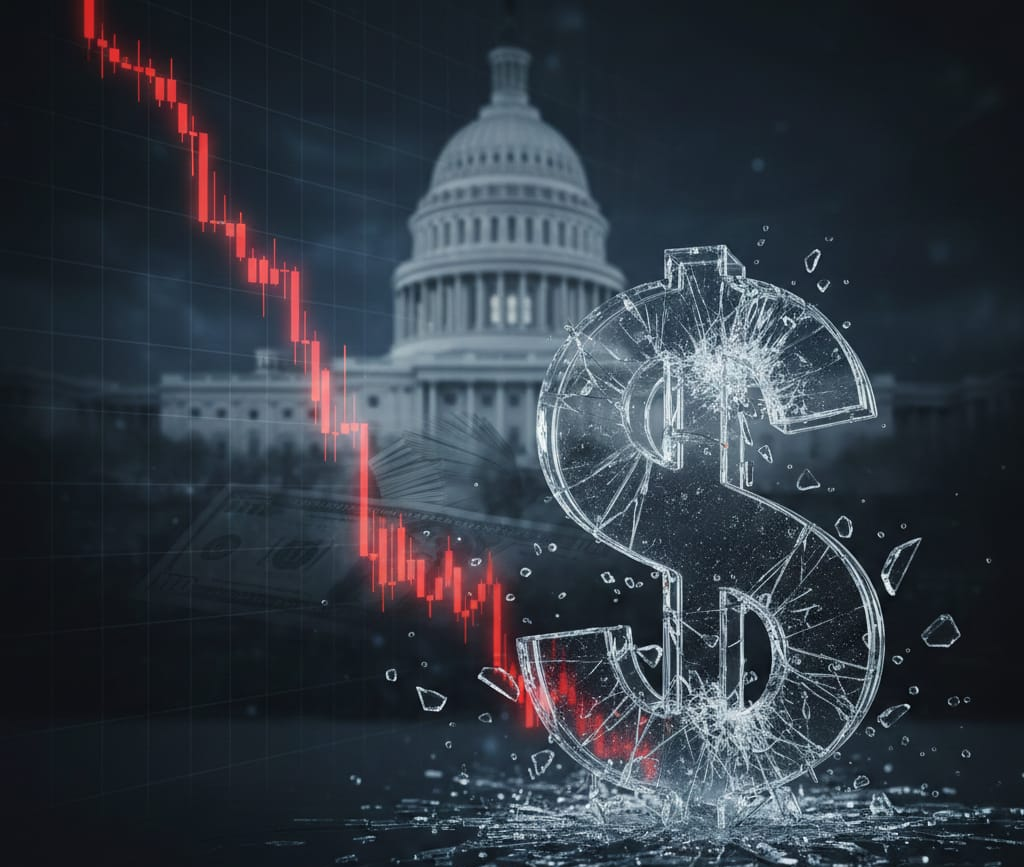
US Dollar Collapse January 2026
US Dollar Collapse

What makes this decline exceptional is the context. Historically, geopolitical tension or the threat of conflict triggers a “flight to safety,” where investors flock to the dollar. Currently, international instability and rising tensions surrounding Iran would typically strengthen the Greenback.

This time, the opposite occurred: the world fled from the dollar. For many market observers, this serves as definitive proof that confidence in the US currency has been fundamentally compromised.

A Convergence of Geopolitical Crises

​The causes of this sell-off extend beyond domestic economic figures, pointing toward a massive shift in the global order. The dollar is no longer seen as the inevitable safe harbor in times of war:

  • Erosion of the “Safe Haven” Status: The traditional logic that investors buy dollars during Middle Eastern unrest has failed. As tensions around Iran escalate, the market is actively decoupling from US assets, signaling a profound lack of trust in American diplomatic and military stability.
  • Fiscal and Political Vulnerability: A rapidly mounting national debt, paired with chronic budget deficits, has left the US vulnerable. International partners are increasingly wary of a government facing persistent political paralysis, questioning its ability to lead on the world stage.
  • Structural Weakening: With US consumer confidence at its lowest since 2014, the “economic engine” that once backed the dollar’s global dominance appears to be sputtering, making the currency a risky bet for foreign capital.

A Historic Turning Point

Analysts are beginning to view this sell-off as a historic inflection point. The long-held status of the dollar as the “ultimate safe haven” is being severely, and perhaps permanently, undermined. As investors conclude they can no longer trust the US government with their capital, we are witnessing a shift in the global financial hierarchy.

​While some contrarians argue that this is merely a temporary dip, given the lack of a viable alternative, the market’s reaction to geopolitical unrest suggests a deeper shift. If the dollar no longer serves as the world’s refuge during a crisis, its reign as the de facto global currency may be entering its twilight.

You might also like: How Americans Have Been ‘Borrowing’ Money from the Rest of the World for Decades Without Consequences

How ‘Trumponomics’ Revives a Forgotten Economic Worldview

The Great Plundering Can Begin

Will the United States, under Donald Trump’s leadership, lean toward an authoritarian capitalism similar to China’s model? His protectionist ideology, inspired by a forgotten and assassinated president, can be summarized in four words: “We are America, bitch.”

U.S. President-elect Donald Trump walks with Elon Musk before attending a viewing of the launch of the sixth test flight of the SpaceX Starship rocket, in Brownsville, Texas, U.S., November 19, 2024 . Brandon Bell/Pool via REUTERS

The U.S. Economy Under Trump in 2029

By January 1, 2029, the United States feels emptier. Contrary to analysts’ predictions that President Trump would scale back his rhetoric, he has kept his promises. Eleven million undocumented immigrants have been deported during his second term. This has significantly impacted a total workforce of 160 million people. Yet, the economy thrives: the oil sector operates without restrictions, and Wall Street enjoys freedom from stringent financial regulations. The result? Businesses are flooded with cheap energy and loans.

Import tariffs—60% on Chinese products and 10-20% on others—have further revitalized America’s declining industries. Store shelves are now filled with goods Made in America. The cherry on top? Income tax has been abolished. Hardworking Americans no longer fund their government directly—foreigners do, thanks to protectionist tariffs.

It’s a vision Trump outlined in a rally in Arizona before his sweeping victory in the fall of 2024:

“We’ll ensure low taxes, minimal regulations, cheap energy, low interest rates, and low inflation so that everyone can afford groceries, a car, and a beautiful home.”

This Trumpian utopia—a fantasy, of course—raises questions. What is the essence of his economic worldview? For many supporters, the answer is simple: it’s not an ideology but common sense. That term appears 12 times in the Republican Party’s brief election manifesto. Despite low unemployment and a booming economy under President Joe Biden, the document paints a grim picture: “For decades, politicians sold our jobs and livelihoods to the highest overseas bidders with unfair trade deals and blind faith in globalism’s siren song.”

Now, with the presidency, Senate, and House under Republican control, Trump’s team declares: “America will once again be the richest, most powerful nation, built on Truth, Justice, and Common Sense.”

The Return of Protectionism

While Trump’s supporters see this as pragmatic, critics argue otherwise. Antonio Gramsci observed that every dominant societal view cloaks itself as apolitical common sense. Trump’s economic preferences are anything but neutral. Commentators dissect his policies—dubbed “Trumponomics” or “Maganomics”—to uncover their essence.

From the start in 2016, Trump’s economic strategy was dual-faced. Domestically, he embraced neoliberalism: tax cuts (mostly benefiting elites), deregulation, and endless tweets lauding stock market growth as a success metric. Internationally, Trump adopted economic nationalism, with China bearing the brunt, followed by Europe through higher tariffs on steel and aluminum.

Trump’s second term shifts gears. His administration promises even more tax cuts for U.S.-based manufacturers and slashes government spending, aiming to save $2 trillion, led by Elon Musk and former candidate Vivek Ramaswamy. Yet, tensions simmer as sectors like construction and hospitality face labor shortages, exacerbated by mass deportations and tariffs.

Echoes of Mercantilism

Trump’s vision of the economy mirrors mercantilism—a nationalist economic ideology dominant between 1600 and 1800. In this zero-sum view, wealth is finite, and nations must outcompete others to secure it. Protectionist tariffs serve as tools for economic supremacy.

Critics, including 16 Nobel laureates and Moody’s Analytics, predict rising inflation and a potential recession by mid-2025. Nevertheless, Trump dismisses these concerns, citing “common sense.”

The Bigger Picture: Toward Authoritarian Capitalism?

Trump’s policies, reminiscent of mercantilism and protectionism, contrast sharply with the Washington Consensus of the 1990s, which advocated liberal economic policies. Instead, his vision seems closer to the Beijing Consensus, emphasizing state-led capitalism and undermining democratic norms.

Analysts warn of the long-term costs. Studies show that populist and authoritarian leaders rarely deliver sustained economic growth, often prioritizing personal enrichment and political power over national prosperity.

In Trump’s America, protectionism isn’t merely policy—it’s an ideology cloaked in common sense, where the international economy is viewed as a battlefield rather than a collaborative space. As Trump declared in 1990: “I’d impose a tax on every Mercedes-Benz and Japanese product entering the U.S.” Decades later, that vision has taken center stage.

Original piece written in Dutch by Koen Haegens.