

A solar eclipse is one of nature’s most awe-inspiring sights. It occurs when the Moon passes directly between Earth and the Sun, blocking all or part of the Sun’s light. Depending on the alignment and distance between Earth, the Moon, and the Sun, an eclipse can be total, partial, or annular (where a brilliant “ring of fire” remains visible around the dark lunar disk).
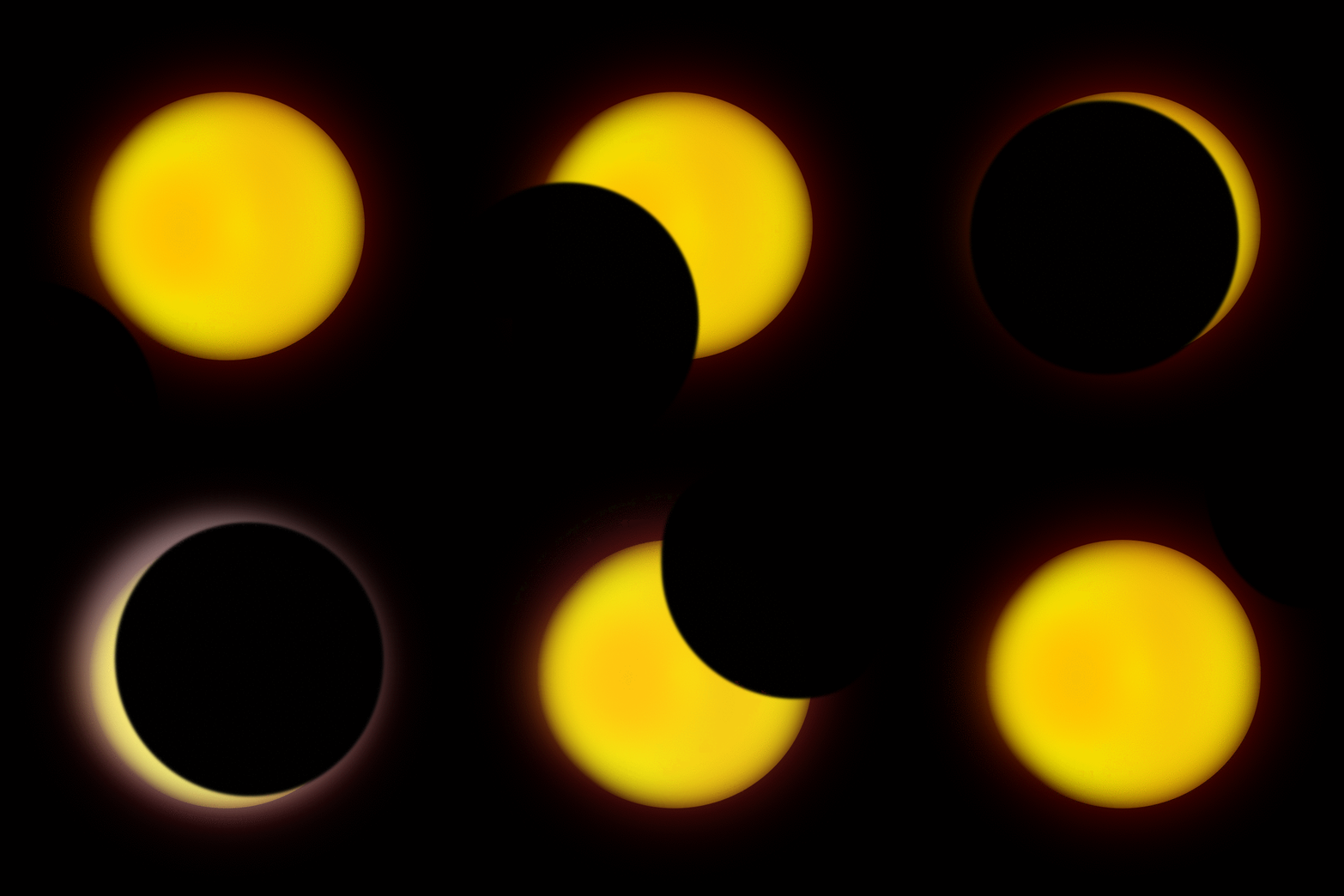
During a total solar eclipse, the Moon completely covers the Sun’s bright face, briefly plunging the landscape into mid-day darkness and revealing the Sun’s outer atmosphere, known as the corona.
Today, August 12, the total solar eclipse will be visible in Europe (Northern Spain, Iceland, and the extreme northeast of Portugal), as well as in Greenland and the Arctic region of Russia. A partial eclipse is visible across the rest of Europe (including the Netherlands and Belgium), North America (including Canada and the US), and Northwest Africa.
Fun Facts About Solar Eclipses
A Cosmic Coincidence: The Sun is approximately 400 times wider than the Moon, but it is also roughly 400 times farther away from Earth. Because of this rare spatial ratio, both objects appear almost identical in size when viewed from Earth’s surface, making total eclipses possible.
Super-Fast Shadows: The Moon’s shadow moves across Earth’s surface at extreme speeds, ranging from 1,700 kilometers per hour (1,000 mph) up to over 8,000 kilometers per hour (5,000 mph) near the poles.
Sudden Temperature Drops: When totality occurs, the sudden loss of sunlight causes ambient temperatures to drop rapidly, typically by 5 to 8 degrees Celsius (10 to 15 degrees Fahrenheit).
Confused Wildlife: As darkness falls during the day, animals often get fooled into thinking night has arrived. Songbirds stop singing, nocturnal creatures wake up, and bees return to their hives.
Baily’s Beads & The Diamond Ring: Right before totality begins or ends, sunlight shines through the valleys and mountains along the edge of the Moon. This creates bright points of light called Baily’s Beads. When only one single point of light remains, it creates a striking image that resembles a diamond ring.
They Will Eventually Stop: The Moon is drifting away from Earth at a rate of roughly 3.8 centimeters (1.5 inches) per year. In about 600 million years, the Moon will be too far away to fully cover the Sun, meaning total solar eclipses will eventually cease to exist.