

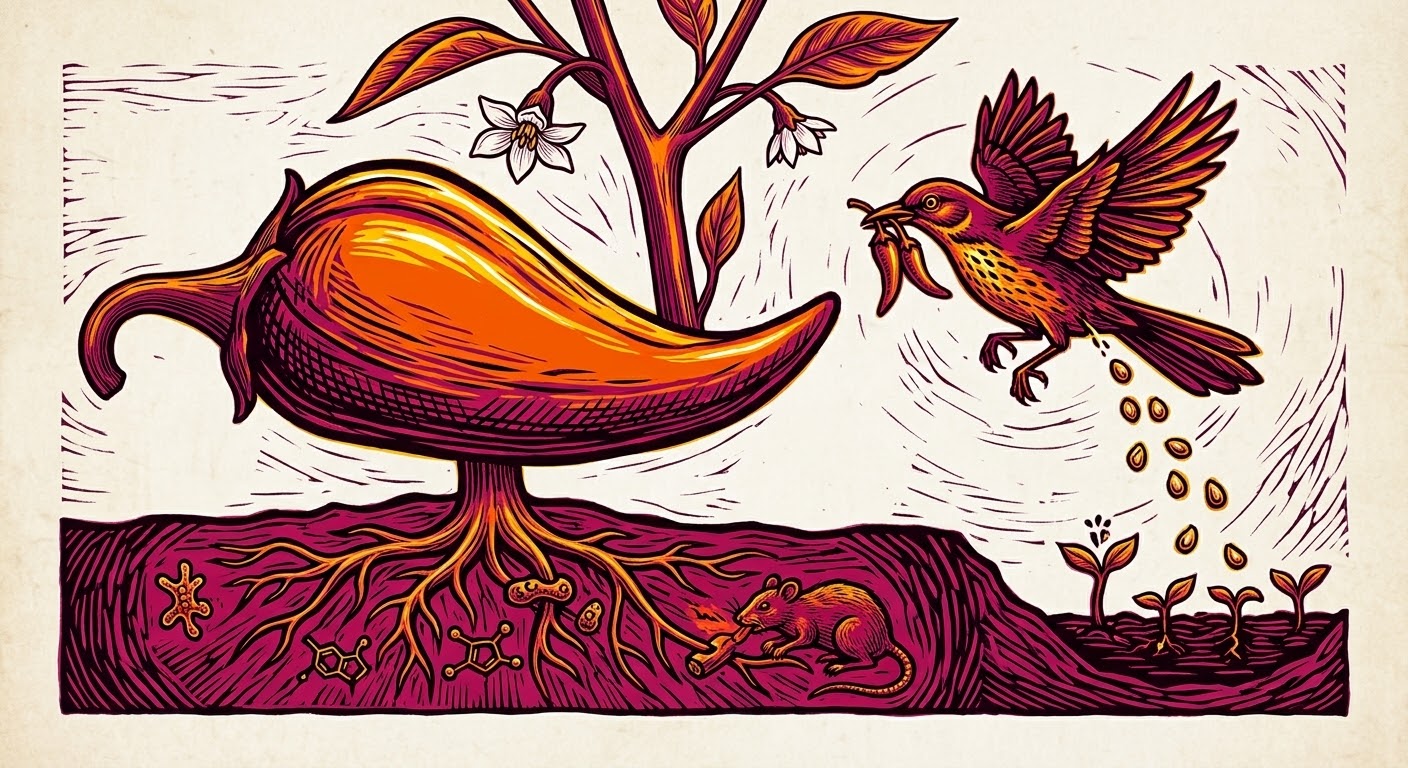
Biting into a fiery chili can feel like breathing actual flames. That searing heat is not just a culinary thrill; it is the result of a brilliant evolutionary survival strategy centered on a single chemical compound: capsaicin.
Targeted Defense and Seed Dispersal
Chili peppers developed capsaicin primarily as a dual defense mechanism. In their native habitats across Central and South America, wild peppers faced threats from seed bugs that introduced damaging Fusarium fungi. Capsaicin naturally inhibits fungal growth, protecting the developing fruit from rotting on the branch.
At the same time, capsaicin acts as a targeted deterrent against mammals. When rodents chew on chili peppers, their molars crush the seeds, rendering them unable to germinate. Birds, on the other hand, possess a genetic variation in their pain receptors that makes them completely immune to capsaicin. They swallow the nutritious berries whole and excrete the seeds undamaged in ideal, shaded environments under trees.
The Pioneering Insights of Joshua Tewksbury
This sophisticated interplay between fungi, mammals, and birds was largely unraveled by the pioneering research of American evolutionary biologist Joshua Tewksbury. Through extensive fieldwork, particularly with wild chili populations in Bolivia and Arizona, Tewksbury demonstrated how capsaicin allows the plant to selectively direct its reproductive fate. He famously used comparative feeding trials to show that desert mice completely avoid pungent chilies, while curve-billed thrashers consume them freely. Crucially, his later work revealed the complex trade-offs: while capsaicin is a vital defense against Fusarium fungi in wet environments, producing it is energetically costly, leading to populations of non-pungent chilies in drier regions where the fungal threat is lower.
Tricking the Brain: The Molecular Breakthrough
The precise biological mechanism behind this burning sensation caused by capsaicin was a mystery until American physiologist David Julius made a groundbreaking discovery in the late 1990s. This achievement, for which he was awarded the 2021 Nobel Prize in Physiology or Medicine, revealed that mammalian nerve cells contain a specific heat-sensing receptor called TRPV1, which normally activates only at temperatures of 43°C (109°F) or higher. Julius proved that capsaicin binds directly to this exact receptor, triggering a structural shift that opens the ion channel and sends a false alarm of extreme heat to the brain. He also showed that birds have a slight mutation in their version of the TRPV1 receptor, rendering it insensitive to capsaicin and confirming the molecular basis of the bird-plant mutualism discovered in the field.
Pain, Pleasure, and Medicine
While the resulting physical reaction (sweating, watering eyes, and a racing pulse) feels intense, capsaicin causes no actual tissue damage. In response to the perceived pain, the brain releases dopamine and endorphins, producing a mild euphoria that explains why many people actively seek out increasingly spicy food. Repeated exposure depletes substance P, a neurotransmitter responsible for pain signaling, which is why capsaicin is also used therapeutically in creams and patches to alleviate chronic nerve pain.
Measuring the Heat
Chili heat is measured in Scoville Heat Units (SHU), a system developed by Wilbur Scoville in 1912. While modern laboratories use gas chromatography for objective measurements, the scale remains the standard benchmark:
- Bell Pepper: 0 SHU (a natural mutation in the Pun1 gene prevents capsaicin synthesis)
- Jalapeño: 2,500 to 8,000 SHU
- Madame Jeanette: 150,000 to 300,000 SHU
- Carolina Reaper: ~1.6 million SHU
- Pepper X: 2.69 million SHU
- Pure Capsaicin: 16,000,000 SHU
A pepper’s baseline heat is determined genetically by complex biosynthetic pathways starting from the amino acid phenylalanine. However, growing conditions also play a notable role: subjecting a chili plant to controlled environmental stress triggers it to produce higher concentrations of capsaicin as a protective response.
Global Domination
Indigenous to the Americas for at least 10,000 years across five domesticated Capsicum species, chilies spread worldwide after Spanish and Portuguese explorers introduced them to Europe, Africa, and Asia at the end of the 15th century. They integrated quickly into cuisines already rich in traditional spices like ginger, mustard, and black peppercorns.
In an ironic evolutionary twist, the very chemical designed to repel predators has ensured the chili pepper’s global cultivation and survival.
Hi Roel,
I really enjoyed reading this fascinating piece, and it resonates completely because I have a genuine passion for hot peppers and spicy food! What I love most is the incredible diversity of flavors they offer, ranging from the bright, citrusy punch of a habanero to the deep, smoky warmth of a chipotle. Beyond just heat, peppers add complexity, depth, and excitement to any dish. That distinct endorphin rush from the capsaicin turns every meal into a vibrant, memorable culinary experience.
What makes this particularly fascinating is the science behind it. Interestingly, research suggests that testosterone levels are linked to spicy food preferences and pepper tolerance, with higher levels associated with a greater appetite for capsaicin. Maybe you can write something about this? And what about yourself, do you like spicy food? 🔥🌶️
Keep up the good work 🙂
Courtney
I love spicy food!!!
Spicy food is also very healthy!!
It provides significant health benefits primarily due to capsaicin, a compound in chili peppers that boosts metabolic rate, increases fat burning, and reduces systemic inflammation. Regular consumption also supports cardiovascular health by lowering blood pressure and LDL cholesterol, enhances gut microbiome diversity, and is statistically associated with a longer lifespan.
Håkon
Norway