

Reflecting on history often becomes vivid when visiting the places where it unfolded. Having recently spent two weeks in Sardinia, the continuity of the past feels particularly close.
Interestingly, when Rome annexed the island in 238 BC, it marked the beginning of nearly seven centuries of uninterrupted Roman presence, a profound integration that explains why the modern Sardinian language remains grammatically and phonetically closer to classical Latin than almost any other Romance language.
This deep structural resilience mirrors the broader reality of the Western Roman Empire’s final years, where the collapse is frequently framed in modern narratives as a sudden, cataclysmic rupture, though the reality for the people living through it was entirely different.
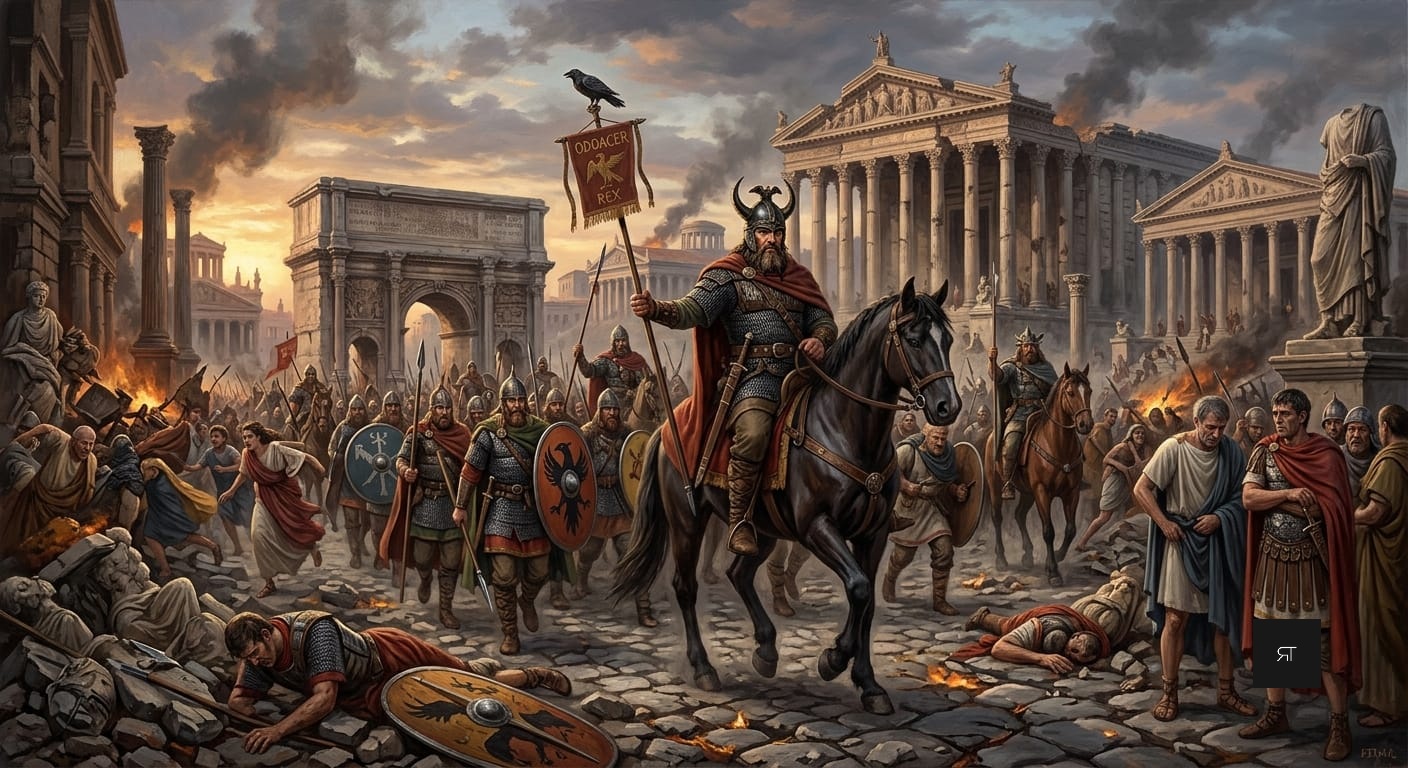
The famous date of September 4, 476 AD, when Romulus Augustulus surrendered his crown to Odoacer, was by no means recorded by contemporaries as the official end of an empire.
The vast majority of Romans living in Italy, Gaul, Spain, or North Africa continued their daily routines without noticing any dramatic shifts in governance, law, or material conditions. The exact same Roman legal codes remained active, the same roads carried the same merchant traffic, and the existing administrative systems collected taxes and settled legal disputes just as they had before. The only real difference was that Germanic leaders now commanded these structures instead of a Roman emperor.
Traditional political institutions also proved remarkably resilient. The Roman Senate continued its sessions for decades after 476 AD. Furthermore, the office of the Roman consul, the highest civilian magistracy dating back to the early Republic, was appointed annually until 534 AD, nearly sixty years after the conventional date of Rome’s fall. Roman administrative titles, legal terminology, and cultural practices persisted across the former Western territories for generations.
What actually concluded in 476 AD was merely the specific political office of a Western Roman emperor. This role had already been increasingly nominal, heavily contested, and entirely dependent on military backing for decades. Odoacer simply decided to stop maintaining the fiction of a civilian emperor ruling above him.
The concept of 476 AD as the definitive fall of Rome was largely constructed by later historians. Most notably, the 18th-century historian Edward Gibbon popularized this narrative in his monumental work, “The History of the Decline and Fall of the Roman Empire.” He selected this specific date as a convenient watershed moment in a massive transformative process that had already been unfolding for centuries, and would continue to do so for centuries to come.
Ultimately, what most Romans experienced in 476 AD was not a sudden collapse, but a continuation. It was a gradual evolution that, over multiple generations, would eventually alter society enough for future historians to look back and use the word “ended.”
¡Gracias! Estoy trabajando en mi proyecto escolar y esta información me ha resultado muy útil.
Un cordial saludo,
Caspar (de Valladolid)