


The Russian economy has entered an ‘endstage’, according to economists in a report published by the German Kiel Institute for the World Economy. The authors warn that ‘an economic collapse of Russia’ is a distinct possibility.
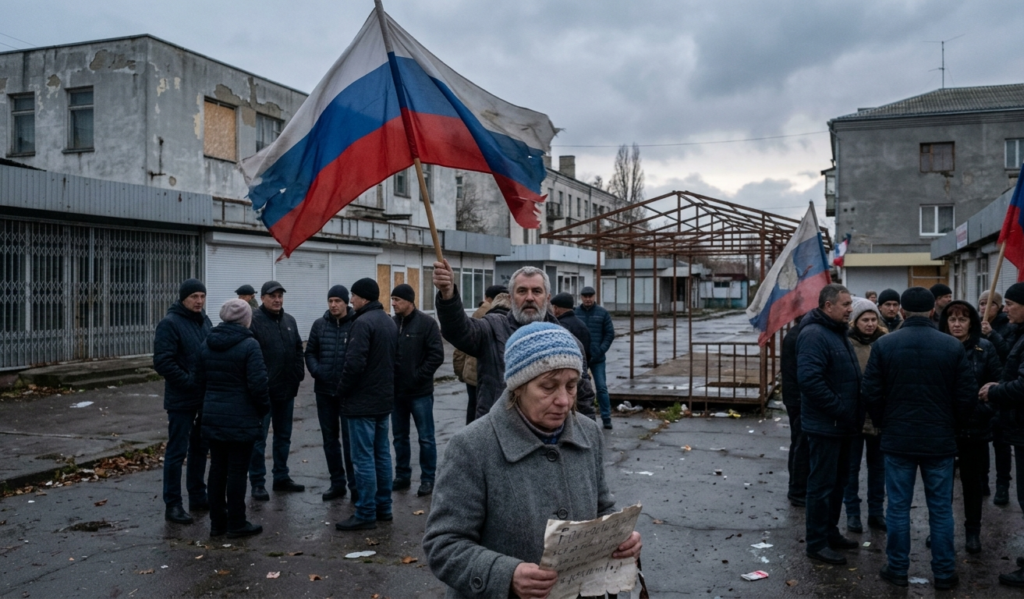
Earlier in May, the Russian central bank adjusted its outlook, projecting a 0.5% contraction of the economy rather than the previously anticipated 1.6% growth. According to the report, even this revised forecast is likely ‘too optimistic’, raising further doubts regarding the accuracy of official data.
Growth is now confined strictly to the Russian defense sector, while the civilian economy stagnates. The report notes that Russian foreign trade volumes have hit a 15-year low, and fixed asset investments have ground to a near-total standstill.
High inflation leaves the Russian central bank with virtually no room to lower interest rates, which currently stand at 14.5%. Furthermore, Russia’s financial reserves are largely depleted. At the outbreak of the war, the National Wealth Fund held reserves equivalent to roughly 6.5% of gross domestic product (GDP). These reserves have now dwindled to 1.8% of GDP.
Oil
Following Ukrainian strikes on Russian oil infrastructure, Russian oil production dropped to a one-year low in May. Over the past month, Ukraine launched at least 31 attacks targeting refineries and pipelines inside Russia. A monthly report from the oil cartel OPEC indicates that Russia produced an average of just over 9 million barrels of crude oil per day in May.
As a result of these attacks, Russian oil processing volume has dropped in June to its lowest level in two decades, according to estimates by analysts at the consultancy firm Energy Aspects.
The report reveals that higher oil prices driven by conflicts in the Middle East offer only temporary relief to the state budget, as export volumes have fallen significantly. Nevertheless, revenue from oil and gas exports remains ‘by far the most critical variable’ funding the war machine. Consequently, the economists call for stricter enforcement of sanctions and the introduction of a special import duty on remaining trade with Russia, with the proceeds used to support Ukraine.
Dependence on China
A key point highlighted in the report is Russia’s growing dependence on China. The economists describe this relationship as increasingly lopsided: China purchases Russian raw materials at a discount, while Russia buys Chinese goods at premium prices. Report co-author Alicia García-Herrero notes that while Moscow has received an ‘economic lifeline’, China is the one dictating ‘the terms of the relationship’. Although trade with China enables Russia to sustain its war economy, it leaves Moscow more vulnerable in the long term due to restricted economic autonomy.
Russian Regions
The report notes that many poorer Russian regions have benefited from increased defense spending, narrowing the income and wage gap within the country. High salaries offered to military recruits also contribute to this trend.
Earlier this month, data showed that Russian regions are collectively facing record deficits this year due to the war. According to Russian Finance Minister Anton Siluanov, the deficit this year will rise by 400 billion rubles ($5.3 billion) compared to last year. An increasing number of Russian regions are heading toward financial shortfalls. While 49 provinces recorded a deficit last year, 73 regions are expected to be in the red this year, the finance minister reported. Siluanov acknowledged the severity of the situation, noting that regional deficits typically total between 200 and 300 billion rubles.
Last year, the total reached 1,500 billion rubles, and at least another 400 billion will be added this year, pushing the final figure close to 2,000 billion rubles.