

The European Union and India have reached a historic free trade agreement following nearly twenty years of negotiations. Described as one of the largest trade deals ever brokered, the pact establishes a trade zone encompassing two billion people.
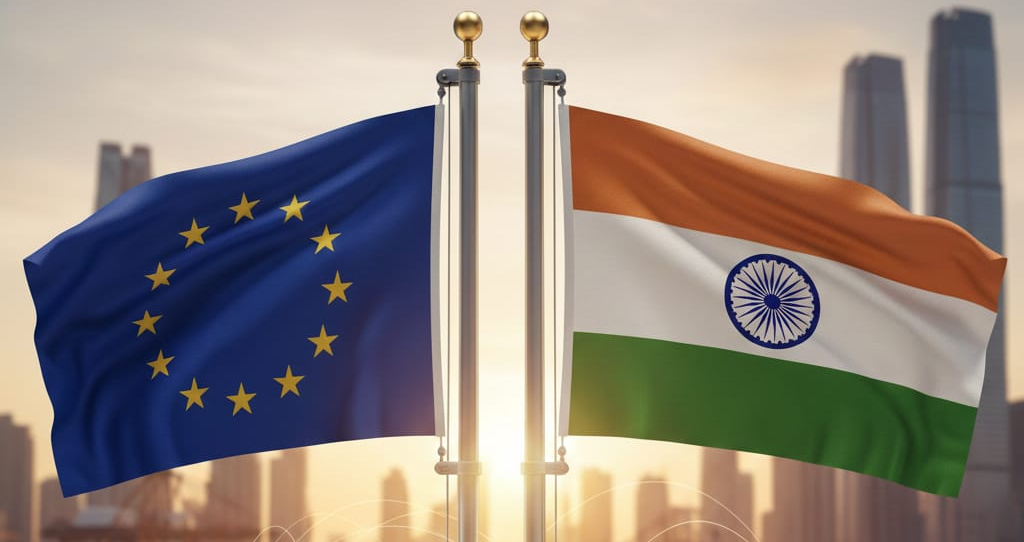
”We have created a free trade zone for two billion people that will benefit both sides,” says European Commission President Ursula von der Leyen.
Indian Prime Minister Narendra Modi echoed this sentiment, stating: “This agreement will unlock immense opportunities for India’s 1.4 billion citizens and millions across Europe.” Together, the EU and India account for 25% of the world’s gross domestic product (GDP).
According to the Commission, the deal is expected to double European exports to India. However, the agreement still requires formal approval from EU Member States and the European Parliament before the new regulations take effect.
Cars and Wine: Slashing Tariffs
Trade in goods between the two blocs has already doubled over the past decade. This new treaty aims to eliminate approximately 90% of existing tariffs between Europe and India.
The deal offers a significant boost to the European automotive industry, with Indian import duties on European cars set to plummet from 110% to just 10%. European winemakers also stand to gain, as tariffs on their products will drop from 150% to approximately 25%.
Shifting Geopolitics: Seeking New Allies
The timing of the accord is inextricably linked to the economic trajectory of the United States. The Trump administration recently imposed a 50% import tariff on India due to its trade in Russian oil, while simultaneously threatening the EU with new levies.
In response, the EU and India are seeking to reduce their dependence on the U.S. by strengthening bilateral ties. “This is only the beginning,” Von der Leyen emphasized. “We will continue to expand and reinforce our strategic partnership, demonstrating to the world that rules-based cooperation still delivers exceptional results.”
A Broader Trade Offensive
The India deal is part of a wider EU strategy to secure global economic partnerships. Von der Leyen is also pushing for the swift implementation of the Mercosur agreement—a trade pact recently finalized with Brazil, Argentina, Uruguay, and Paraguay.
The Mercosur deal has faced delays, however, as the European Parliament awaits a ruling from the European Court of Justice. Lawmakers have expressed concerns regarding the agreement’s impact on the competitive position of European farmers.
Beyond India and Mercosur, the EU is actively negotiating deals with Australia, Malaysia, the Philippines, Thailand, and the United Arab Emirates. Recent agreements have already been secured with Indonesia and Mexico.
The trade treaty with India is not yet final; it must still be ratified by India, the EU Member States, and the European Parliament.
Promising deal, but I do have a few critical remarks:
Agriculture vs. Industry: How will the EU protect the interests of European farmers, who are already under immense pressure due to the Mercosur agreement, when the Indian agricultural market opens up further?
Sustainability and Labor Rights: To what extent does this deal include enforceable clauses regarding human rights and environmental standards, areas where the EU traditionally sets strict demands but India often asserts its sovereignty?
Ratification Hurdles: Given that national parliaments in the EU often take years to grant approval (as seen with CETA), how realistic is the swift implementation envisioned by Von der Leyen in the current political climate?